Application
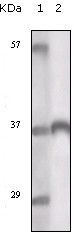
Western blot analysis using Tyro3 antibody against truncated Tyro3 recombinant protein.Application
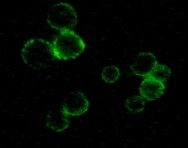
Immunofluorescense staining of methanol - fixed MCF - 7 (top) and HepG - 2 (bottom) cells showing membrane / cyoplasma localization.| Product Name | TYRO3 Antibody |
|---|---|
| Antibody Type | Primary Antibodies |
| Antigen Alias | BYK, DTK, RSE, SKY, TIF, Tyrosine-protein kinase BYKBYK, Dtk, Sky, Tif |
| Product description | Tyrosine-protein kinase (TYRO3) belongs to the Tyr protein kinase family (AXL/UFO subfamily). The UFO family of receptor tyrosine kinases is comprised of subfamily members Rse(also referred to as Tyro3 or Sky) and UFO (also called Tyro7 or Axl). Two distinct isoforms of Rse, designated Brt and Etk-2, have been described. Brt differs from Rse at its C-terminus, but more importantly lacks the N-terminal 31 amino acid signal peptide sequence present in Rse, which is replaced by a 27 amino acid Brt-specific sequence. It has been suggested that as a result of this alternative splicing event, Brt resides in the cytoplasm, unlike Rse which is expressed on the cell surface. Ekt-2 also lacks an N-terminal signal peptide which is substituted with a 45 amino acid Ekt-2-specific sequence. Protein kinases mediate most of the signal transduction in eukaryotic cells, regulating cellular metabolism, transcription, cell cycle progression, cytoskeletal rearrangement and cell movement, apoptosis, and differentiation.1) Janssen, J.W.G., et al. 1991. Oncogene 6: 2113-2120. |
| Immunogen | Ni-NTA purified truncated recombinant TYRO3 expressed in E. Coli strain BL21 (DE3). |
| Clonality | Monoclonal |
|---|---|
| Isotype | IgG1 |
| Host Species | Mouse |
| Tested Applications | ELISAIFWB |
| Western Blot:1:500 - 1:2,000 IF:1:50 - 1:200 ELISA:Propose dilution 1:10,000. Determining optimal working dilutions by titration test.: |
|
| Species Reactivity | Human |
| Concentration | 1mg/ml |
| Gene Symbol | TYRO3 |
|---|---|
| Alternative Names | BYK DTK RSE SKY TIF Tyrosine-protein kinase BYKBYK Dtk Sky Tif |
| Sequence Similarities | 2) Cat. No. 1211 - HepG2 Cell Lysate |
Application
Western blot analysis using Tyro3 antibody against truncated Tyro3 recombinant protein.
Application
Immunofluorescense staining of methanol - fixed MCF - 7 (top) and HepG - 2 (bottom) cells showing membrane / cyoplasma localization.| Positive Control | 1) Cat. No. 1219 - MCF7 Cell Lysate |
|---|---|
| Application Notes | Western Blot:1:500 - 1:2,000 IF:1:50 - 1:200 ELISA:Propose dilution 1:10,000. Determining optimal working dilutions by titration test.: |
| Form | Liquid |
|---|---|
| Storage Instructions | TYRO3 monoclonal antibody can be stored at -20˚C, stable for one year. As with all antibodies care should be taken to avoid repeated freeze thaw cycles. Antibodies should not be exposed to prolonged high temperatures. |
| Storage Buffer | Ascitic fluid containing 0.03% sodium azide. |


