Application
Tyrosine Hydroxylase (Phospho-Ser31) Antibody| Product Name | Tyrosine Hydroxylase (phospho Ser31) Antibody |
|---|---|
| Antibody Type | Primary Antibodies |
| Antigen Alias | The, Tyrosine 3-hydroxylase, TH |
| Product description | Tyrosine Hydroxylase (TH) is the rate-limiting enzyme in the synthesis of the catecholamines Dopamine and Norepinephrine. TH antibodies can therefore be used as markers for dopaminergic and noradrenergic neurons. We raised this polyclonal antibody against a peptide representing the sequence around Ser19 in rat TH purified. This antibody is suitable for most immunochemical applications in a variety of mammalian and some non-mammalian species.1) Witkovsky, P., Gabriel, R., Haycock, J. W., and Meller, E., "Influence of light and neural circuitry on tyrosine hydroxylase phosphorylation in the rat retina," J. Chem. Neuroanat., 19 (2000) 105 - 116. |
| Immunogen | TH (Ser31) polyclonal antibody was raised against a synthetic phosphopeptide corresponding to amino acids residues surrounding the phospho-Ser31 of rat tyrosine hydroxylase (TH). |
| Modification | p-Ser31 |
| Clonality | Polyclonal |
|---|---|
| Host Species | Rabbit |
| Tested Applications | IFIHCWB |
| Applications include Dot Blots (DB), Immunoblotting (IB), Immunofluorescence (IF), Immunohistochemistry (IHC) and Western Blots (WB). Mouse and rat have 100% amino acid sequence identity with the antigen used to raise the antibody. When internally tested under ideal conditions the working dilutions were 1:1000 for IF, IHC, DB and WB.: |
|
| Species Reactivity | MouseRat |
| Concentration | 1mg/ml |
| Purification | Affinity purified |
| Gene Symbol | Th |
|---|---|
| Alternative Names | The Tyrosine 3-hydroxylase TH |
| Molecular Weight(MW) | 60 |
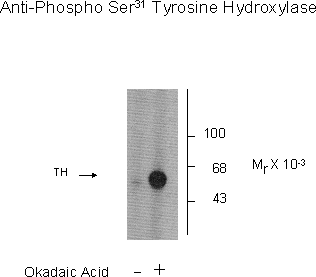
| Tissue Specificity | Tyrosine Hydroxylase antibody is specific for the 60k Tyrosine Hydroxylase phosphorylated at Ser31 in PC-12 cells stimulated by Okadaic Acid. |
Application
Tyrosine Hydroxylase (Phospho-Ser31) Antibody| Application Notes | Applications include Dot Blots (DB), Immunoblotting (IB), Immunofluorescence (IF), Immunohistochemistry (IHC) and Western Blots (WB). Mouse and rat have 100% amino acid sequence identity with the antigen used to raise the antibody. When internally tested under ideal conditions the working dilutions were 1:1000 for IF, IHC, DB and WB.: |
|---|
| Form | Liquid |
|---|---|
| Storage Instructions | For long term storage –80˚C is recommended, but shorter term storage at –20˚C is also acceptable as aliquots may be taken without freeze/thawing due to the presence of 50% glycerol. Stable for one year. |
| Storage Buffer | 100 uL in 10 mM HEPES (pH 7.5), 150 mM NaCl, 100 ug per mL BSA and 50% glycerol. |


