Application
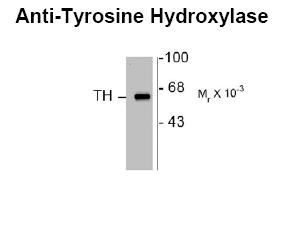
Western blot of 10 ug of rat caudate lysate showing specific immunolabeling of the ~60k TH protein.| Product Name | Tyrosine Hydroxylase Antibody |
|---|---|
| Antibody Type | Primary Antibodies |
| Antigen Alias | The, Tyrosine 3-hydroxylase, TH |
| Product description | Tyrosine hydroxylase (TH) is the rate-limiting enzyme in the synthesis of the catecholamines dopamine and norepinephrine. TH antibodies can therefore be used as markers for dopaminergic and noradrenergic neurons in a variety of applications including depression, schizophrenia, Parkinson’s disease and drug abuse (Kish et al., 2001; Zhu et al., 2000; Zhu et al., 1999). TH antibodies can also be used to explore basic mechanisms of dopamine and norepinephrine signaling (Witkovsky et al., 2000; Salvatore et al., 2001; Dunkley et al., 2004).1) Dunkley PR, Bobrovskaya L, Graham ME, Von Nagy-Felsobuki EI, Dickson PW (2004) Tyrosine hydroxylase phosphorylation: regulation and consequences. J Neurochem 91:1025-1043. |
| Immunogen | SDS-denatured rat tyrosine hydroxylase, purified from pheochromocytoma. |
| Clonality | Polyclonal |
|---|---|
| Host Species | Rabbit |
| Tested Applications | IFIHCWB |
| IF:1:200~1:500 IHC:1:50~1:200 WB:1:500~1:2000 Notes:Optimal dilutions/concentrations should be determined by the researcher. |
|
| Species Reactivity | Mammalian species |
| Concentration | 1mg/ml |
| Purification | Affinity purified |
| Gene Symbol | Th |
|---|---|
| Alternative Names | The Tyrosine 3-hydroxylase TH |
| Molecular Weight(MW) | 60 |
| Tissue Specificity | Specific for the ~60k tyrosine hydroxylase protein. |
Application
Western blot of 10 ug of rat caudate lysate showing specific immunolabeling of the ~60k TH protein.| Application Notes | IF:1:200~1:500 IHC:1:50~1:200 WB:1:500~1:2000 Notes:Optimal dilutions/concentrations should be determined by the researcher. |
|---|
| Form | Liquid |
|---|---|
| Storage Instructions | Tyrosine Hydroxylase antibody can be stored at -20˚C and is stable at -20˚C for at least 1 year. |
| Storage Buffer | 100 uL in 10 mM HEPES (pH 7.5), 150 mM NaCl, 100 ug per mL BSA and 50% glycerol. |


