Application
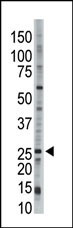
Antibody is used in Western blot to detect UBCH9 in Jurkat cell lysate.| Product Name | UBCH9 Antibody |
|---|---|
| Antibody Type | Primary Antibodies |
| Antigen Alias | Ubiquitin-conjugating enzyme E2 E3, UbcH9, Ubiquitin carrier protein E3, Ubiquitin-conjugating enzyme E2-23 kDa, Ubiquitin-protein ligase E3, UBE2E3, UBCE4, UBCH9 |
| Product description | The modification of proteins with ubiquitin is an important cellular mechanism for targeting abnormal or short-lived proteins for degradation. Ubiquitination involves at least three classes of enzymes: ubiquitin-activating enzymes, or E1s, ubiquitin-conjugating enzymes, or E2s, and ubiquitin-protein ligases, or E3s. UBCH9 is a member of the E2 ubiquitin-conjugating enzyme family. The encoded protein shares 100% sequence identity with the mouse and rat counterparts, which indicates that this enzyme is highly conserved in eukaryotes. Two alternatively spliced transcript variants encoding the same protein have been found.1) Ito, K., et al., Cytogenet. Cell Genet. 84 (1-2), 99-104 (1999). |
| Immunogen | This UBCH9 antibody is generated from rabbits immunized with a KLH conjugated synthetic peptide between 176-206 amino acids from the C-terminal region of human UBCH9. |
| Clonality | Polyclonal |
|---|---|
| Isotype | Ig |
| Host Species | Rabbit |
| Tested Applications | WB |
| For WB starting dilution is: 1:1000: |
|
| Species Reactivity | Human |
| Concentration | 1mg/ml |
| Gene Symbol | UBE2E3 |
|---|---|
| Alternative Names | Ubiquitin-conjugating enzyme E2 E3 UbcH9 Ubiquitin carrier protein E3 Ubiquitin-conjugating enzyme E2-23 kDa Ubiquitin-protein ligase E3 UBE2E3 UBCE4 UBCH9 |
| Molecular Weight(MW) | 23 kDa |
| Sequence Similarities | Predicted species reactivity based on immunogen sequence: Bovine |
Application
Antibody is used in Western blot to detect UBCH9 in Jurkat cell lysate.| Application Notes | For WB starting dilution is: 1:1000: |
|---|
| Form | Liquid |
|---|---|
| Storage Instructions | Store at 4˚C for three months and -20˚C, stable for up to one year. As with all antibodies care should be taken to avoid repeated freeze thaw cycles. Antibodies should not be exposed to prolonged high temperatures. |
| Storage Buffer | Supplied in PBS with 0.09% (W/V) sodium azide. |


