Application
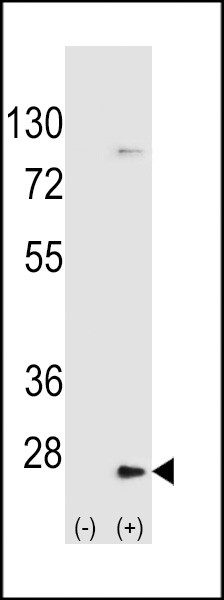
Western blot analysis of UBE2H using rabbit polyclonal UBE2H Antibody (S167) using 293 cell lysates (2 ug/lane) either nontransfected (Lane 1) or transiently transfected (Lane 2) with the UBE2H gene.| Product Name | UBE2H Antibody |
|---|---|
| Antibody Type | Primary Antibodies |
| Antigen Alias | Ubiquitin-conjugating enzyme E2 H, UbcH2, Ubiquitin carrier protein H, Ubiquitin-conjugating enzyme E2-20K, Ubiquitin-protein ligase H, UBE2H |
| Product description | The modification of proteins with ubiquitin is an important cellular mechanism for targeting abnormal or short-lived proteins for degradation. Ubiquitination involves at least three classes of enzymes: ubiquitin-activating enzymes, or E1s, ubiquitin-conjugating enzymes, or E2s, and ubiquitin-protein ligases, or E3s. UBE2H is a member of the E2 ubiquitin-conjugating enzyme family. The encoded protein sequence is 100% identical to the mouse homolog and 98% identical to the frog and zebrafish homologs, which indicates that this enzyme is highly conserved in eukaryotes.1) Hayashida, S., et al., Genomics 66(2):221-225 (2000). |
| Immunogen | This UBE2H antibody is generated from rabbits immunized with a KLH conjugated synthetic peptide between 153-183 amino acids from the C-terminal region of human UBE2H. |
| Clonality | Polyclonal |
|---|---|
| Isotype | Ig |
| Host Species | Rabbit |
| Tested Applications | WB |
| For WB starting dilution is: 1:1000: |
|
| Species Reactivity | Human |
| Concentration | 1mg/ml |
| Purification | Affinity purified |
| Gene Symbol | UBE2H |
|---|---|
| Alternative Names | Ubiquitin-conjugating enzyme E2 H UbcH2 Ubiquitin carrier protein H Ubiquitin-conjugating enzyme E2-20K Ubiquitin-protein ligase H UBE2H |
| Molecular Weight(MW) | 21 kDa |
| Sequence Similarities | Predicted species reactivity based on immunogen sequence: Bovine |
Application
Western blot analysis of UBE2H using rabbit polyclonal UBE2H Antibody (S167) using 293 cell lysates (2 ug/lane) either nontransfected (Lane 1) or transiently transfected (Lane 2) with the UBE2H gene.| Application Notes | For WB starting dilution is: 1:1000: |
|---|
| Form | Liquid |
|---|---|
| Storage Instructions | Store at 4˚C for three months and -20˚C, stable for up to one year. As with all antibodies care should be taken to avoid repeated freeze thaw cycles. Antibodies should not be exposed to prolonged high temperatures. |
| Storage Buffer | Supplied in PBS with 0.09% (W/V) sodium azide. |


