Application
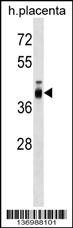
Western blot analysis in human placenta tissue lysates (35ug/lane).| Product Name | ZP3 Antibody |
|---|---|
| Antibody Type | Primary Antibodies |
| Antigen Alias | Zona pellucida sperm-binding protein 3, Sperm receptor, ZP3A/ZP3B, Zona pellucida glycoprotein 3, Zp-3, Zona pellucida protein C, Processed zona pellucida sperm-binding protein 3, ZP3, ZP3A, ZP3B, ZPC |
| Product description | The zona pellucida is an extracellular matrix that surrounds the oocyte and early embryo. It is composed primarily of three or four glycoproteins with various functions during fertilization and preimplantation development. The protein encoded by this gene is a structural component of the zona pellucida and functions in primary binding and induction of the sperm acrosome reaction. The nascent protein contains a N-terminal signal peptide sequence, a conserved ZP domain, a C-terminal consensus furin cleavage site, and a transmembrane domain. It is hypothesized that furin cleavage results in release of the mature protein from the plasma membrane for subsequent incorporation into the zona pellucida matrix. However, the requirement for furin cleavage in this process remains controversial based on mouse studies. A variation in the last exon of this gene has previously served as the basis for an additional ZP3 locus; however, sequence and literature review reveals that there is only one full-length ZP3 locus in the human genome. Another locus encoding a bipartite transcript designated POMZP3 contains a duplication of the last four exons of ZP3, including the above described variation, and maps closely to this gene.1) Davila, S., et al. Genes Immun. 11(3):232-238(2010) |
| Immunogen | This ZP3 antibody is generated from rabbits immunized with a KLH conjugated synthetic peptide between 353-380 amino acids from the C-terminal region of human ZP3. |
| Clonality | Polyclonal |
|---|---|
| Isotype | Ig |
| Host Species | Rabbit |
| Tested Applications | WB |
| For WB starting dilution is: 1:1000: |
|
| Species Reactivity | Human |
| Concentration | 1mg/ml |
| Purification | Affinity purified |
| Gene Symbol | ZP3 |
|---|---|
| Alternative Names | Zona pellucida sperm-binding protein 3 Sperm receptor ZP3A/ZP3B Zona pellucida glycoprotein 3 Zp-3 Zona pellucida protein C Processed zona pellucida sperm-binding protein 3 ZP3 ZP3A ZP3B ZPC |
| Molecular Weight(MW) | 47 kDa |
Application
Western blot analysis in human placenta tissue lysates (35ug/lane).| Application Notes | For WB starting dilution is: 1:1000: |
|---|
| Form | Liquid |
|---|---|
| Storage Instructions | Store at 4˚C for three months and -20˚C, stable for up to one year. As with all antibodies care should be taken to avoid repeated freeze thaw cycles. Antibodies should not be exposed to prolonged high temperatures. |
| Storage Buffer | Supplied in PBS with 0.09% (W/V) sodium azide. |


