Application
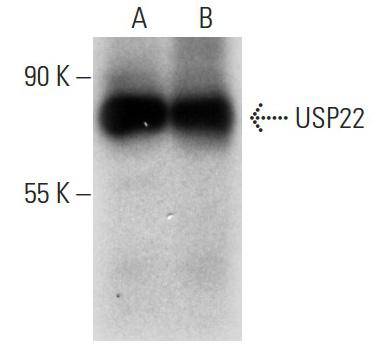
Fig1: Western blot analysis of USP22 expression in HeLa (A) and Jurkat (B) whole cell lysates.Application
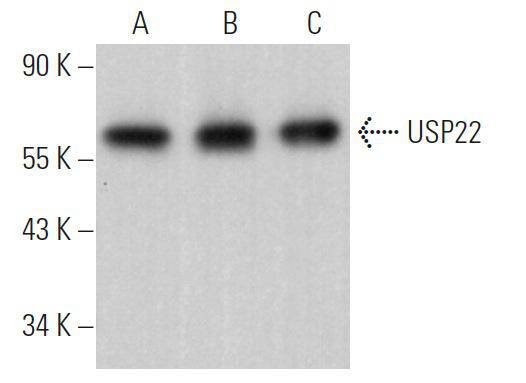
Fig2: Western blot analysis of USP22 expression in Jurkat (A), Caco-2 (B) and F9 (C) whole cell lysates.| Product Name | USP22 [1G4] |
|---|---|
| Antibody Type | Primary Antibodies |
| Antigen Alias | Deubiquitinating enzyme 22 antibody KIAA1063 antibody Ubiquitin carboxyl terminal hydrolase 22 antibody Ubiquitin carboxyl-terminal hydrolase 22 antibody Ubiquitin specific peptidase 22 antibody Ubiquitin specific peptidase 3 like antibody Ubiquitin specific processing protease 22 antibody Ubiquitin specific protease 22 antibody Ubiquitin thioesterase 22 antibody Ubiquitin thiolesterase 22 antibody Ubiquitin-specific-processing protease 22 antibody UBP22_HUMAN antibody USP 22 antibody Usp22 antibody USP3L antibody |
| Product description | The ubiquitin (Ub) pathway involves three sequential enzymatic steps that facilitate the conjugation of Ub and Ub-like molecules to specific protein substrates. Through the use of a wide range of enzymes that can add or remove ubiquitin, the Ub pathway controls many intracellular processes such as signal transduction, transcriptional activation and cell cycle progression. USP22 (ubiquitin specific peptidase 22), also known as USP3L, is a 525 amino acid protein that contains one UBP-type zinc finger and functions to catalyze the conversion of a ubiquitin C-terminal thioester to free ubiquitin and thiol, a reaction that may influence several cellular processes. Via its catalytic activity, USP22 is thought to play an important role in cell cycle progression and may also serve as a cancer stem cell marker. The gene encoding USP22 maps to human chromosome 17, which comprises over 2.5% of the human genome and encodes over 1,200 genes. |
| Immunogen | Amino acids 130-176 mapping within an internal region of USP22 of human origin. |
| Clonality | Monoclonal |
|---|---|
| Isotype | IgG1 |
| Host Species | Mouse |
| Tested Applications | WBIPIFICC/IF |
| WB:1:100-1:1,000 IP:1-2 μg per 100-500 μg of total protein (1 ml of cell lysate) IF:1:50-1:500 ELISA:1:30-1:3000 |
|
| Species Reactivity | Human |
| Concentration | 2mg/ml |
| Alternative Names | Deubiquitinating enzyme 22 antibody KIAA1063 antibody Ubiquitin carboxyl terminal hydrolase 22 antibody Ubiquitin carboxyl-terminal hydrolase 22 antibody Ubiquitin specific peptidase 22 antibody Ubiquitin specific peptidase 3 like antibody Ubiquitin specific processing protease 22 antibody Ubiquitin specific protease 22 antibody Ubiquitin thioesterase 22 antibody Ubiquitin thiolesterase 22 antibody Ubiquitin-specific-processing protease 22 antibody UBP22_HUMAN antibody USP 22 antibody Usp22 antibody USP3L antibody |
|---|---|
| Molecular Weight(MW) | 60 kDa |
| Cellular Localization | Nucleus |
| SwissProt ID | Q9UPT9 |
|---|
Application
Fig1: Western blot analysis of USP22 expression in HeLa (A) and Jurkat (B) whole cell lysates.
Application
Fig2: Western blot analysis of USP22 expression in Jurkat (A), Caco-2 (B) and F9 (C) whole cell lysates.| Positive Control | Jurkat whole cell lysate, HeLa whole cell lysate. |
|---|---|
| Application Notes | WB:1:100-1:1,000 IP:1-2 μg per 100-500 μg of total protein (1 ml of cell lysate) IF:1:50-1:500 ELISA:1:30-1:3000 |
| Form | Liquid |
|---|---|
| Storage Instructions | Store at +4℃ |
| Storage Buffer | 1*TBS (pH7.4), 1%BSA, 40%Glycerol. Preservative: 0.05% Sodium Azide. |


