IF-P
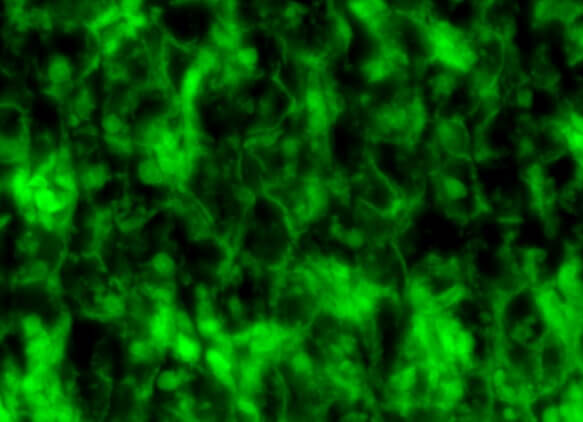
Immunofluorescence staining of red snapper liver tissue fixed in formalin and embedded in paraffin showed 8-OHdG staining in liver cells.| Product Name | Mouse Monoclonal antibody to 8-OHdG |
|---|---|
| Antibody Type | Primary Antibodies |
| Immunogen | raised against 8-hy-droxy-2'-deoxyguanosine (8-OHdG)-BCP conjugate of synthetic origin. |
| Clonality | monoclonal |
|---|---|
| Isotype | IgM,k |
| Host Species | Mouse |
| Tested Applications | IF-PIHC |
| IHC:1:50-1:500 IF-P:1:50-1:500 |
|
| Species Reactivity | All |
| Concentration | 0.2mg/ml |
| Purification | Affinity purified |
| Function | DNA or RNA damage can hinder the ability of a cell to carry out its function and can significantly increase the likelihood of tumor formation. One of the causes of damaged DNA and RNA is oxidation of the bases. 8-hydroxy-2'-de oxyguanosine, 8-hydroxyguanine (8-OHdG) and 8-hydroxyguanosine are all markers of oxidative damage to RNA and DNA. 8-hydroxy-2'-deoxyguanosine is produced by reactive oxygen and nitrogen species, including hydroxyl rad ical and peroxynitrite. 8-hydroxyguanine is one of the major base lesions in volved in mutagenesis and is caused by ionizing radiation and radiomimetic agents. 8-hydroxyguanosine induces a transversion of G to T in DNA, which may be mutagenic. Markers of DNA and RNA damage are useful research tools when studying the effects of this type of damage. |
|---|
IF-P
Immunofluorescence staining of red snapper liver tissue fixed in formalin and embedded in paraffin showed 8-OHdG staining in liver cells.| Application Notes | IHC:1:50-1:500 IF-P:1:50-1:500 |
|---|
| Form | Liquid |
|---|---|
| Storage Instructions | Store at 4° C, **DO NOT FREEZE**. Stable for one year from the date of shipment. Non-hazardous. No MSDS required. |
| Storage Buffer | Each vial contains 200 µg IgM kappa light chain in 1.0 ml of PBS with < 0.1% sodium azide and 0.1% gelatin. |


