ICC/IF
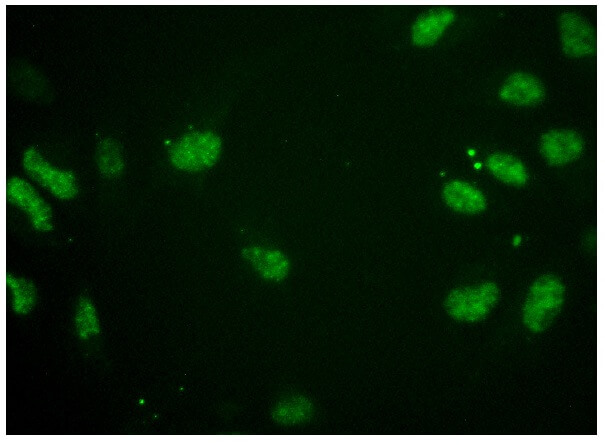
Immunofluorescence staining of HeLa cells fixed in formalin showed nuclear localization.| Product Name | Mouse Monoclonal antibody to pADPr |
|---|---|
| Antibody Type | Primary Antibodies |
| Immunogen | raised against poly(ADP-ribose) mixed with methylated bovine serum albumin |
| Clonality | monoclonal |
|---|---|
| Isotype | IgG3 |
| Host Species | Mouse |
| Tested Applications | ICC/IFWB |
| WB:1:100-1:1000 ICC/IF:1:50-1:500 |
|
| Species Reactivity | All |
| Concentration | 0.1mg/ml |
| Purification | Affinity purified |
| Function | Poly(ADP-ribosylation) is a method of DNA damage-dependent posttransla tional modification that helps to rescue injured proliferating cells from cell death. The PARP (poly[ADP-ribose] polymerase) proteins comprise a super family of enzymes that functionally modify histones and other nuclear pro teins, thereby preventing cell death. PARPs use NAD+ as a substrate to cat alytically transfer ADP-ribose residues onto protein acceptors; a process that, when repeated multiple times, leads to the formation of poly(ADP-ribose) (pADPr) chains that exist either independently or attached to a target protein. The presence of these chains alters the function of the target protein and promotes cell survival. Additionally, pADPr chains are thought to be important for cell-cycle progression and cellular responses to DNA damage. |
|---|
ICC/IF
Immunofluorescence staining of HeLa cells fixed in formalin showed nuclear localization.| Application Notes | WB:1:100-1:1000 ICC/IF:1:50-1:500 |
|---|
| Form | Liquid |
|---|---|
| Storage Instructions | Store at 4° C, **DO NOT FREEZE**. Stable for one year from the date of shipment. Non-hazardous. No MSDS required. |
| Storage Buffer | Each vial contains 100 µg IgG3 in 1.0 ml PBS with < 0.1% sodium azide and 0.1% gelatin. |


