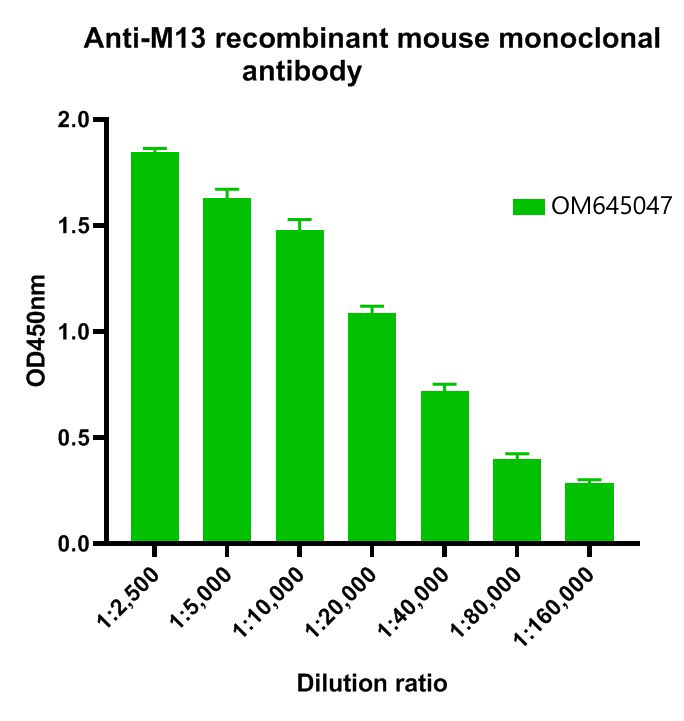
ELISA
Indirect ELISA analysis of M13 was performed by coating HSA/BSA (2 μg/mL in pH 9.6 carbonate buffer) in 96-well plate, and then add the indicated amounts of M13 Bacteriophages displaying anti-HSA Fab overnight at 4℃. Incubated with 100 µl per well of anti-M13 monoclonal antibody starting at a dilution of 1/2,500 and serially diluting it to a dilution of 1:160,000 for 1 hours at room temperature. The plate was washed and incubated with 50 µl per well of an HRP-conjugated goat anti-Mouse IgG secondary antibody at a dilution of 1:10,000 for one hour at room temperature. Detection was performed using an Ultra TMB Substrate for 10 minutes at room temperature in the dark. The reaction was stopped with sulfuric acid and absorbances were read on a spectrophotometer at 450 nm.| Product Name | M13 Recombinant Mouse Monoclonal Antibody |
|---|---|
| Antibody Type | Primary Antibodies |
| Immunogen | M13 Bacteriophage. |
| Clonality | Monoclonal |
|---|---|
| Isotype | IgG1 |
| Host Species | Mouse |
| Tested Applications | ELISA |
| ELISA:1:2500-1:20000 |
|
| Species Reactivity | Bacteriophage |
| Concentration | 1mg/ml |
| Purification | Protein A |
| Alternative Names | Bacteriophage M13 antibody Coliphage M13 antibody Enterobacteria phage M13 antibody M13 virus antibody Phage M13 antibody |
|---|---|
| Function | M13 is a filamentous bacteriophage composed of circular single stranded DNA (ssDNA) which is 6407 nucleotides long encapsulated in approximately 2700 copies of the major coat protein P8, and capped with 5 copies of two different minor coat proteins (P9, P6, P3) on the ends. Infection with filamentous phages is not lethal, however the infection causes turbid plaques in E. coli. It is a non-lytic virus. However a decrease in the rate of cell growth is seen in the infected cells. M13 plasmids are used for many recombinant DNA processes, and the virus has also been studied for its uses in nanostructures and nanotechnology. The phage coat is primarily assembled from a 50 amino acid protein called pVIII (or p8), which is encoded by gene VIII (or g8) in the phage genome. For a wild type M13 particle, it takes about approximately 2700 copies of p8 to make the coat about 900 nm long. The coat's dimensions are flexible though and the number of p8 copies adjusts to accommodate the size of the single stranded genome it packages. The general stages to a viral life cycle are: infection, replication of the viral genome, assembly of new viral particles and then release of the progeny particles from the host. Filamentous phage use a bacterial structure known as the F pilus to infect E. coli, with the M13 p3 tip contacting the TolA protein on the bacterial pilus. The phage genome is then transferred to the cytoplasm of the bacterial cell where resident proteins convert the single stranded DNA genome to a double stranded replicative form. |
ELISA
Indirect ELISA analysis of M13 was performed by coating HSA/BSA (2 μg/mL in pH 9.6 carbonate buffer) in 96-well plate, and then add the indicated amounts of M13 Bacteriophages displaying anti-HSA Fab overnight at 4℃. Incubated with 100 µl per well of anti-M13 monoclonal antibody starting at a dilution of 1/2,500 and serially diluting it to a dilution of 1:160,000 for 1 hours at room temperature. The plate was washed and incubated with 50 µl per well of an HRP-conjugated goat anti-Mouse IgG secondary antibody at a dilution of 1:10,000 for one hour at room temperature. Detection was performed using an Ultra TMB Substrate for 10 minutes at room temperature in the dark. The reaction was stopped with sulfuric acid and absorbances were read on a spectrophotometer at 450 nm.| Application Notes | ELISA:1:2500-1:20000 |
|---|
| Form | Liquid |
|---|---|
| Storage Instructions | Store at +4℃ after thawing. Aliquot store at -20℃. Avoid repeated freeze / thaw cycles. |
| Storage Buffer | PBS (pH7.4), 0.05% Sodium Azide. |


