WB
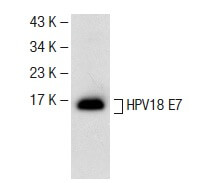
Western blot analysis of HPV18 E7 expression in HeLa whole cell lysate.ICC/IF
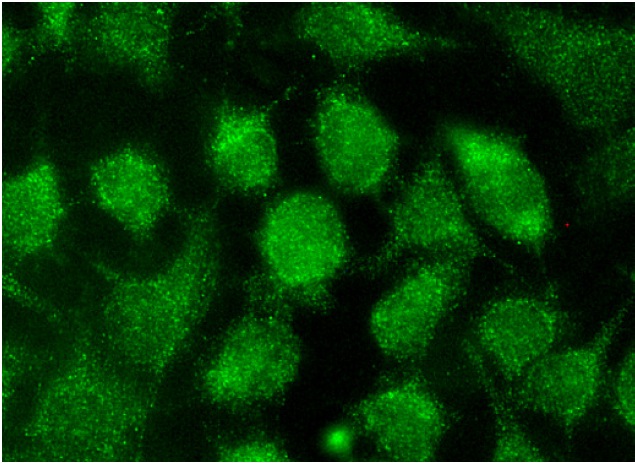
Immunofluorescence staining of methanol fixed HeLa cells revealed nuclear and cytoplasmic localization.| Product Name | Mouse Monoclonal antibody to HPV18 E7 |
|---|---|
| Antibody Type | Primary Antibodies |
| Immunogen | specific for an epitope mapping between amino acids 3-27 at the N-terminus of HPV18 E7 of viral origin. |
| Clonality | monoclonal |
|---|---|
| Isotype | IgG1, k |
| Host Species | Mouse |
| Tested Applications | ICC/IFWB |
| WB:1:100-1:1000 ICC/IF:1:50-1:500 |
|
| Species Reactivity | Human |
| Concentration | 0.2mg/ml |
| Purification | Affinity purified |
| Target | Human papilloma viruses (HPVs) can be classified as either high risk or low risk according to their association with cancer. HPV16 and HPV18 are the most common of the high risk group, while HPV6 and HPV11 are among the low risk types. Approximately 90% of cervical cancers contain HPV DNA of the high risk types. Mutational analysis have shown that the E6 and E7 genes of the high risk HPVs are necessary and sufficient for HPV transforming function. The specific interactions of the E6 and E7 proteins with p53 and pRB, respectively, correlate with HPV high and low risk classifications. The high risk HPV E7 proteins bind to pRB with a higher affinity than do the low risk HPV proteins, and only the high risk HPV E6 proteins form detectable complexes with p53 in vitro. |
|---|---|
| Molecular Weight(MW) | 15 kDa |
| Cellular Localization | nuclear,cytoplasmic. |
WB
Western blot analysis of HPV18 E7 expression in HeLa whole cell lysate.
ICC/IF
Immunofluorescence staining of methanol fixed HeLa cells revealed nuclear and cytoplasmic localization.| Application Notes | WB:1:100-1:1000 ICC/IF:1:50-1:500 |
|---|
| Form | Liquid |
|---|---|
| Storage Instructions | Store at 4° C, **DO NOT FREEZE**. Stable for one year from the date of shipment. Non-hazardous. No MSDS required. |
| Storage Buffer | Each vial contains 50 µg IgG1 kappa light chain in 0.5 ml of PBS with < 0.1% sodium azide and 0.1% gelatin. |


