WB
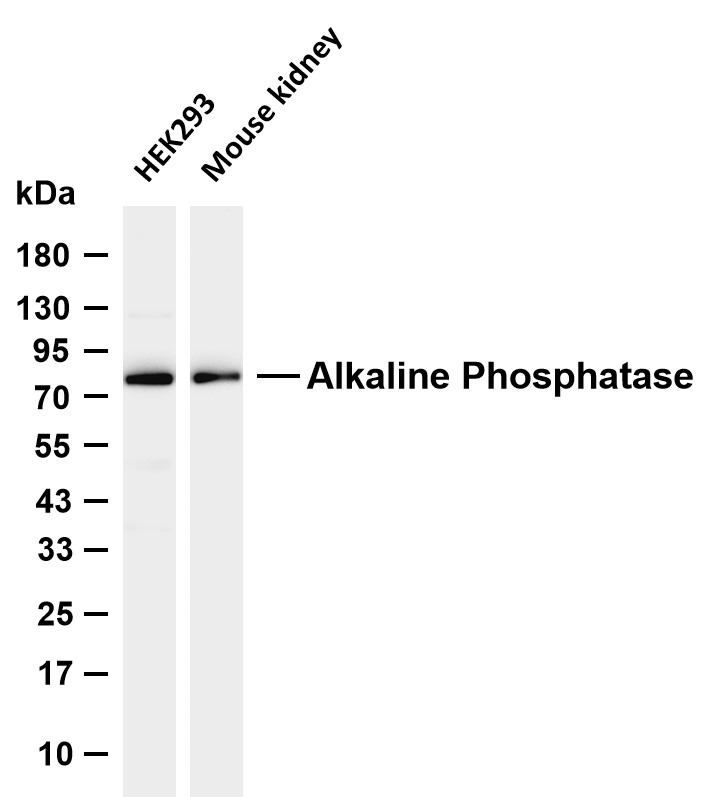
Various whole cell lysates were separated by 4-20% SDS-PAGE, and the membrane was blotted with anti-Alkaline Phosphatase antibody. The HRP-conjugated Goat anti-Rabbit IgG (H + L) antibody was used to detect the antibody.| Product Name | Alkaline Phosphatase Rabbit mAb |
|---|---|
| Antibody Type | Primary Antibodies |
| Clonality | Monoclonal |
|---|---|
| Isotype | IgG,K |
| Host Species | Rabbit |
| Tested Applications | WB |
| WB:1:2000-1:10000 |
|
| Species Reactivity | HumanMouseRat |
| Concentration | 1mg/ml |
| Purification | Protein A |
| Gene Symbol | ALPL |
|---|---|
| Gene Synonyms | HOPS HPPA HPPC HPPI HPPO TNAP TNALP APTNAP TNSALP AP-TNAP TNS-ALP |
| Gene Full Name | alkaline phosphatase, biomineralization associated |
| Gene Summary | This gene encodes a member of the alkaline phosphatase family of proteins. There are at least four distinct but related alkaline phosphatases: intestinal, placental, placental-like, and liver/bone/kidney (tissue non-specific). The first three are located together on chromosome 2, while the tissue non-specific form is located on chromosome 1. The product of this gene is a membrane bound glycosylated enzyme that is not expressed in any particular tissue and is, therefore, referred to as the tissue-nonspecific form of the enzyme. Alternative splicing results in multiple transcript variants, at least one of which encodes a preproprotein that is proteolytically processed to generate the mature enzyme. This enzyme may play a role in bone mineralization. Mutations in this gene have been linked to hypophosphatasia, a disorder that is characterized by hypercalcemia and skeletal defects. [provided by RefSeq, Oct 2015] |
| Alternative Names | ALPL Alkaline phosphatase tissue-nonspecific isozyme AP-TNAP TNSALP Alkaline phosphatase liver/bone/kidney isozyme |
| Molecular Weight(MW) | 57 kDa(Observed band size: 80 kDa) |
| Cellular Localization | Cell membrane ; Lipid-anchor, GPI-anchor . Extracellular vesicle membrane ; Lipid-anchor, GPI-anchor . Mitochondrion membrane ; Lipid-anchor, GPI-anchor . Mitochondrion intermembrane space . Localizes to special class of extracellular vesicles, named matrix vesicles (MVs), which are released by osteogenic cells. Localizes to the mitochondria of thermogenic fat cells: tethered to mitochondrial membranes via a GPI-anchor and probably resides in the mitochondrion intermembrane space. |
WB
Various whole cell lysates were separated by 4-20% SDS-PAGE, and the membrane was blotted with anti-Alkaline Phosphatase antibody. The HRP-conjugated Goat anti-Rabbit IgG (H + L) antibody was used to detect the antibody.| Application Notes | WB:1:2000-1:10000 |
|---|
| Form | Liquid |
|---|---|
| Storage Instructions | -15°C to -25°C/1 year(Do not lower than -25°C) |
| Storage Buffer | PBS, 50% glycerol, 0.05% Proclin 300, 0.05%BSA |


