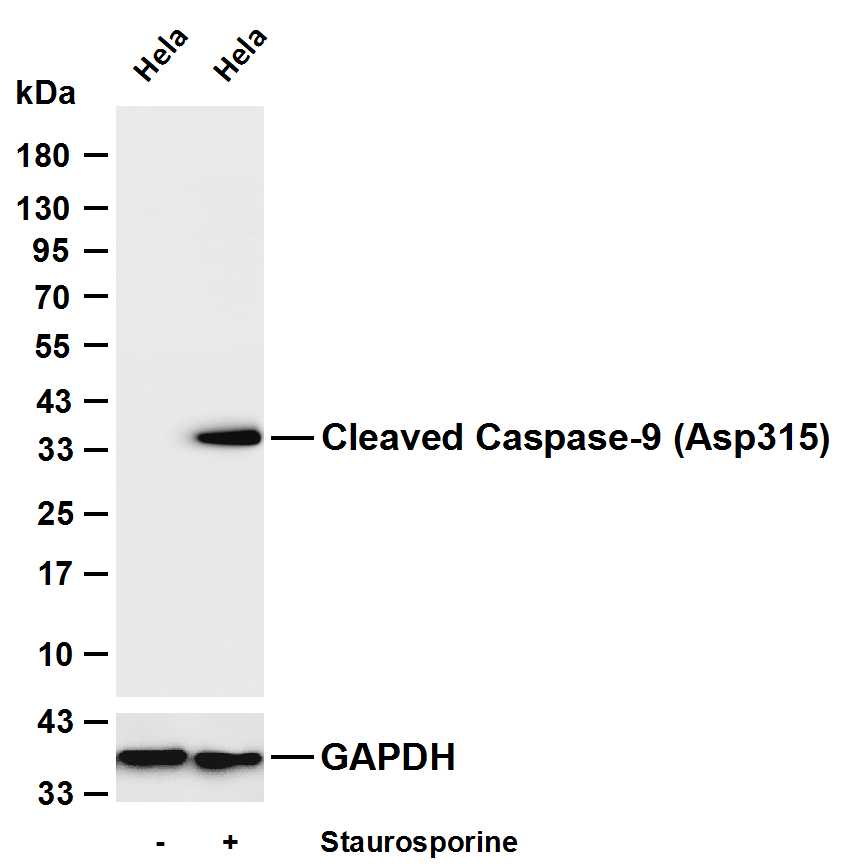
WB
Various whole cell lysates were separated by 4-20% SDS-PAGE, and the membrane was blotted with anti-Cleaved Caspase-9 (Asp315) antibody. The HRP-conjugated Goat anti-Rabbit IgG (H + L) antibody was used to detect the antibody.| Product Name | Cleaved Caspase-9 (Asp315) Rabbit mAb |
|---|---|
| Antibody Type | Primary Antibodies |
| Immunogen | The specific immunogen used to produce this antibody is proprietary information. |
| Clonality | Monoclonal |
|---|---|
| Isotype | IgG,K |
| Host Species | Rabbit |
| Tested Applications | WB |
| WB:1:2000-1:10000 |
|
| Species Reactivity | Human |
| Concentration | 1mg/ml |
| Purification | Protein A |
| Gene Symbol | CASP9 |
|---|---|
| Gene Synonyms | MCH6 APAF3 APAF-3 PPP1R56 ICE-LAP6 |
| Gene Full Name | caspase 9 |
| Gene Summary | This gene encodes a member of the cysteine-aspartic acid protease (caspase) family. Sequential activation of caspases plays a central role in the execution-phase of cell apoptosis. Caspases exist as inactive proenzymes which undergo proteolytic processing at conserved aspartic residues to produce two subunits, large and small, that dimerize to form the active enzyme. This protein can undergo autoproteolytic processing and activation by the apoptosome, a protein complex of cytochrome c and the apoptotic peptidase activating factor 1; this step is thought to be one of the earliest in the caspase activation cascade. This protein is thought to play a central role in apoptosis and to be a tumor suppressor. Alternative splicing results in multiple transcript variants. [provided by RefSeq, May 2013] |
| Alternative Names | CASP9 MCH6 Caspase-9 CASP-9 Apoptotic protease Mch-6 Apoptotic protease-activating factor 3 APAF-3 ICE-like apoptotic protease 6 ICE-LAP6 [Cleaved into: Caspase-9 subunit p35 Caspase-9 subunit p10] |
| Molecular Weight(MW) | 46 kDa(Observed band size: 35 kDa) |
| Cellular Localization | nucleus ,mitochondrion ,cytosol ,apoptosome. |
WB
Various whole cell lysates were separated by 4-20% SDS-PAGE, and the membrane was blotted with anti-Cleaved Caspase-9 (Asp315) antibody. The HRP-conjugated Goat anti-Rabbit IgG (H + L) antibody was used to detect the antibody.| Application Notes | WB:1:2000-1:10000 |
|---|
| Form | Liquid |
|---|---|
| Storage Instructions | -15°C to -25°C/1 year (Do not lower than -25°C). |
| Storage Buffer | PBS, 50% glycerol, 0.05% Proclin 300, 0.05%BSA. |


