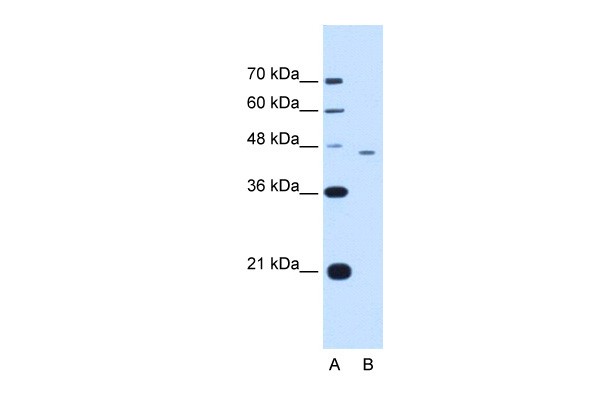
Western blot
1.25ug/mlPositive Control: HepG2 cell lysate| Product Name | Rabbit anti-FEN1 polyclonal antibody - C-terminal region |
|---|---|
| Antibody Type | Primary Antibodies |
| Antigen Alias | FEN-1, MF1, RAD2 |
| Immunogen | The immunogen for anti-FEN1 antibody: synthetic peptide directed towards the C terminal of human FEN1 |
| Clonality | Polyclonal |
|---|---|
| Isotype | IgG |
| Host Species | Rabbit |
| Tested Applications | WB |
| WB:1:500~1:2000 Notes:Optimal dilutions/concentrations should be determined by the researcher. |
|
| Species Reactivity | BovineHorseHumanMouseRabbitRatSheepZebra Fish |
| Concentration | 1mg/ml |
| Purification | Protein A |
| Gene Symbol | FEN1 |
|---|---|
| Gene Synonyms | FEN-1 MF1 RAD2 |
| Gene Full Name | Flap structure-specific endonuclease 1 |
| Gene Summary | FEN1 removes 5' overhanging flaps in DNA repair and processes the 5' ends of Okazaki fragments in lagging strand DNA synthesis. Direct physical interaction between this protein and AP endonuclease 1 during long-patch base excision repair provides coordinated loading of the proteins onto the substrate, thus passing the substrate from one enzyme to another. The protein is a member of the XPG/RAD2 endonuclease family and is one of ten proteins essential for cell-free DNA replication. DNA secondary structure can inhibit flap processing at certain trinucleotide repeats in a length-dependent manner by concealing the 5' end of the flap that is necessary for both binding and cleavage by the protein encoded by this gene. Therefore, secondary structure can deter the protective function of this protein, leading to site-specific trinucleotide expansions.The protein encoded by this gene removes 5' overhanging flaps in DNA repair and processes the 5' ends of Okazaki fragments in lagging strand DNA synthesis. Direct physical interaction between this protein and AP endonuclease 1 during long-patch base excision repair provides coordinated loading of the proteins onto the substrate, thus passing the substrate from one enzyme to another. The protein is a member of the XPG/RAD2 endonuclease family and is one of ten proteins essential for cell-free DNA replication. DNA secondary structure can inhibit flap processing at certain trinucleotide repeats in a length-dependent manner by concealing the 5' end of the flap that is necessary for both binding and cleavage by the protein encoded by this gene. Therefore, secondary structure can deter the protective function of this protein, leading to site-specific trinucleotide expansions. |
| Alternative Names | FEN-1 MF1 RAD2 |
| Molecular Weight(MW) | 42kDa |
| Sequence | 380 amino acids |
Western blot
1.25ug/mlPositive Control: HepG2 cell lysate| Application Notes | WB:1:500~1:2000 Notes:Optimal dilutions/concentrations should be determined by the researcher. |
|---|
| Form | Liquid |
|---|---|
| Storage Instructions | Aliquot and store at -20°C. Avoid repeated freeze / thaw cycles |
| Storage Buffer | phosphate buffered saline , pH 7.4, 150mM NaCl, 0.02% sodium azide and 50% glycerol. |


