Application
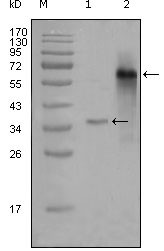
Figure 1: Western blot analysis using anti-NCOA3 monoclonal antibody against truncated Trx-NCOA3 recombinant protein(1) and truncated NCOA3(aa1-200)-hIgGFc transfected CHOK1 cell lysate (2).| Product Name | NCOA3 Antibody |
|---|---|
| Antibody Type | Primary Antibodies |
| Antigen Alias | ACTR; AIB1 |
| Clonality | Monoclonal |
|---|---|
| Isotype | IgG1 |
| Clone Number | 2C11B12 |
| Host Species | Mouse |
| Tested Applications | WB |
| WB:1:500 - 2000. |
|
| Species Reactivity | Human |
| Concentration | 1mg/ml |
| Gene Synonyms | AIB1 BHLHE42 RAC3 TRAM1 |
|---|---|
| Alternative Names | ACTR AIB1 |
| Molecular Weight(MW) | 155293 Da |
| Function | Nuclear receptor coactivator that directly binds nuclear receptors and stimulates the transcriptional activities in a hormone-dependent fashion. Plays a central role in creating a multisubunit coactivator complex, which probably acts via remodeling of chromatin. Involved in the coactivation of different nuclear receptors, such as for steroids (GR and ER), retinoids (RARs and RXRs), thyroid hormone (TRs), vitamin D3 (VDR) and prostanoids (PPARs). Displays histone acetyltransferase activity Also involved in the coactivation of the NF-kappa-B pathway via its interaction with the NFKB1 subunit. Interacts with PSMB9 |
| Tissue Specificity | Widely expressed. High expression in heart, skeletal muscle, pancreas and placenta. Low expression in brain, and very low in lung, liver and kidney |
| Cellular Localization | Cytoplasm. Nucleus. Note=Mainly cytoplasmic and weakly nuclear. Upon TNF activation and subsequent phosphorylation, it translocates from the cytoplasm to the nucleus |
| Entrez Gene | 8202 |
|---|---|
| Nucleotide Accession | NP_858045.1 |
Application
Figure 1: Western blot analysis using anti-NCOA3 monoclonal antibody against truncated Trx-NCOA3 recombinant protein(1) and truncated NCOA3(aa1-200)-hIgGFc transfected CHOK1 cell lysate (2).| Application Notes | WB:1:500 - 2000. |
|---|
| Form | Liquid |
|---|---|
| Storage Instructions | For short-term storage, store at 4° C. For long-term storage, aliquot and store at -20ºC or below. Avoid multiple freeze-thaw cycles. |
| Storage Buffer | Purified recombinant fragment of NCOA3(aa1-200) expressed in E. Coli. |


