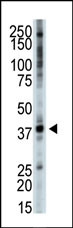
Application
The anti-NPK Pab is used in Western blot to detect NPK in mouse skeletal muscle tissue lysate.| Product Name | TRIB3 Antibody (C-term) |
|---|---|
| Antibody Type | Primary Antibodies |
| Antigen Alias | TRIB3; C20orf97; NIPK; SKIP3; TRB3; Tribbles homolog 3; Neuronal cell death-inducible putative kinase; SINK; p65-interacting inhibitor of NF-kappa-B |
| Clonality | Polyclonal |
|---|---|
| Isotype | Ig |
| Host Species | Rabbit |
| Tested Applications | WB |
| WB:1:100~500 |
|
| Species Reactivity | Human |
| Concentration | 1mg/ml |
| Gene Synonyms | C20orf97 NIPK SKIP3 TRB3 |
|---|---|
| Alternative Names | TRIB3 C20orf97 NIPK SKIP3 TRB3 Tribbles homolog 3 Neuronal cell death-inducible putative kinase SINK p65-interacting inhibitor of NF-kappa-B |
| Molecular Weight(MW) | 39578 Da |
| Function | Disrupts insulin signaling by binding directly to Akt kinases and blocking their activation. May bind directly to and mask the 'Thr-308' phosphorylation site in AKT1. Binds to ATF4 and inhibits its transcriptional activation activity. Interacts with the NF-kappa-B transactivator p65 RELA and inhibits its phosphorylation and thus its transcriptional activation activity Interacts with MAPK kinases and regulates activation of MAP kinases. May play a role in programmed neuronal cell death but does not appear to affect non-neuronal cells. Does not display kinase activity. Inhibits the transcriptional activity of DDIT3/CHOP and is involved in DDIT3/CHOP-dependent cell death during ER stress. Can inhibit APOBEC3A editing of nuclear DNA |
| Tissue Specificity | Highest expression in liver, pancreas, peripheral blood leukocytes and bone marrow. Also highly expressed in a number of primary lung, colon and breast tumors. Expressed in spleen, thymus, and prostate and is undetectable in other examined tissues, including testis, ovary, small intestine, colon, leukocyte, heart, brain, placenta, lung, skeletal muscle, and kidney |
| Cellular Localization | Nucleus. |
| Entrez Gene | 57761 |
|---|
Application
The anti-NPK Pab is used in Western blot to detect NPK in mouse skeletal muscle tissue lysate.| Application Notes | WB:1:100~500 |
|---|
| Form | Liquid |
|---|---|
| Storage Instructions | For short-term storage, store at 4° C. For long-term storage, aliquot and store at -20ºC or below. Avoid multiple freeze-thaw cycles. |
| Storage Buffer | Purified polyclonal antibody supplied in PBS with 0.09% (W/V) sodium azide. This antibody is purified through a protein G column, eluted with high and low pH buffers and neutralized immediately, followed by dialysis against PBS. |


