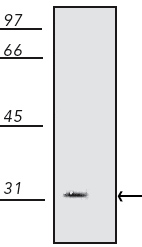
Application
Western blot analysis of human epidermoid carcinoma A431 cell lysate, probed with| Product Name | 14-3-3 beta + zeta antibody |
|---|---|
| Antibody Type | Primary Antibodies |
| Product description | Mouse monoclonal [22 - IID8B] to 14 - 3 - 3 beta + zeta14-3-3 proteins are highly conserved proteins which play a role in both signal transduction and progression through the cell cycle by binding to and regulating several different proteins. 14-3-3 proteins activate tyrosine and tryptophan hydroxylases and protein kinase C. They mediate signal transduction by binding to phosphoserine-containing proteins. There are at least 7 mammalian isoforms: alpha, beta, gamma, delta, epsilon, zeta, and eta. An eighth subtype, termed theta has been found in rat brain. The 14-3-3 proteins exist in vitro and in vivo as either homo- or heterodimers which interact via their N-terminal domains and are subject to phosphorylation by protein kinase C. 14-3-3 proteins are localized in the cytoplasm of neurons in the cerebral cortex and are axonally transported to the nerve terminals. They may be present at lower levels in various other eukaryotic tissues. Northern blot analysis has shown expression of the eta chain in cultured cell lines derived from various tumors. |
| Immunogen | Lysed transformed amnion cells (AMA) (Human). |
| Clonality | Monoclonal |
|---|---|
| Isotype | IgG |
| Clone Number | 22-IID8B |
| Host Species | Mouse |
| Tested Applications | ICC/IFIHCWB |
| ICC: Use at an assay dependent dilution. IHC: Use at a dilution of 1/50. WB: Use at a concentration of 1 μg/ml. Predicted molecular weight: 29 and 30 kDa. Optimal dilutions/concentrations should be determined by the end user.: |
|
| Species Reactivity | HumanMouseDogMonkeyPigRatRabbitSheepBovine |
| Concentration | 1mg/ml |
| Purification | Protein G |
| Gene Synonyms | YWHAA KCIP1 1433 beta + zeta HS1 GW128 14-3-3-zeta KCIP-1 MGC111427 MGC126532 MGC138156 YWHAD KCIP 1 14 3 3 zeta 1433zeta |
|---|---|
| Target | 14-3-3 beta + zeta |
| Cellular Localization | Cytoplasmic |
Application
Western blot analysis of human epidermoid carcinoma A431 cell lysate, probed with| Positive Control | HeLa cell lysate |
|---|---|
| Application Notes | ICC: Use at an assay dependent dilution. IHC: Use at a dilution of 1/50. WB: Use at a concentration of 1 μg/ml. Predicted molecular weight: 29 and 30 kDa. Optimal dilutions/concentrations should be determined by the end user.: |
| Form | Liquid |
|---|---|
| Storage Instructions | Keep as concentrated solution. Store at 4ºC short term. For extended storage aliquot and store at -20ºC or below. Avoid freeze-thaw cycles. |
| Storage Buffer | Preservative: NoneConstituents: 50% Glycerol, PBS, 0.1mM PMSF. pH 7.2 |


