Application
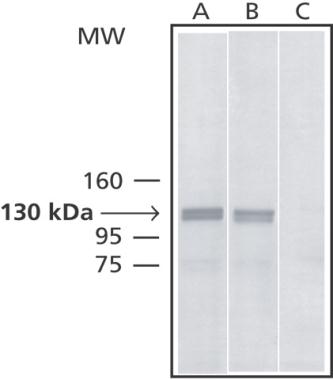
Mouse brain (Lane A, C) and rat brain (Lane B) cytosolic fractions were separated on SDS-PAGE, blotted with Rabbit Anti-ASAP1 (VG-17) and developed with Goat Anti-Rabbit IgG Peroxidase and chemiluminescent substrate. (Lanes A, B) Antibody dilution 1: 2,000; (Lane C) Antibody dilution 1: 2,000 + 20 μg/mL ASAP1 immunizing peptide.| Product Name | ASAP1 antibody |
|---|---|
| Antibody Type | Primary Antibodies |
| Product description | Rabbit polyclonal to ASAP1ADP-ribosylation factors (ARFs) family of GTP binding proteins are involved in the regulation of membrane trafficking and actin cytoskeleton. ASAP1 (ARF GAP containing SH3, ANK repeat and PH domains 1, also known as DEF1 or centaurin beta 4) is a 130 kDa, ADP ribosylation factor GTPase activating protein (ARFGAP). ARFs require ARF-GAPs that stimulate their GTPase activity. ASAP1 belongs to a family of related ARF-GAP proteins, consisting of PAP/DEF2, ACAP1, ACAP2, GIT1/CAT1/APP1, and GIT2/CAT2/PKL, which are involved in the regulation of the actin cytoskeleton and cell migration. ASAP1 binds ARF1 and ARF5, with only modest activity toward ARF6. It also binds to other known regulators of actin cytoskeleton, such as tyrosine kinase Src, Crk, FAK and phosphatidylinositol-4,5-bisphosphate (PIP2). ASAP1 is phosphorylated on tyrosine residues in cells expressing activated Src.ASAP1a and ASAP1b are two variants formed by alternative splicing of the ASAP1 gene. ASAP1 localizes to focal adhesions and cycles with focal adhesion proteins when cells are stimulated to move. Overexpression of ASAP1 alters the morphology of focal adhesions, blocks cell spreading and formation of dorsal ruffles, and prevents the efficient organization of paxillin and FAK in focal adhesions. On the other hand, a mutation disrupting GAP activity of ASAP1 or overexpression of a truncated variant of ASAP1 that fails to bind FAK has a reduced effect on inhibition of cell spreading. By directly interacting with both ARFs and focal adhesion proteins such as paxillin and FAK, ASAP1 plays an important role in the regulation of focal adhesion assembly and cytoskeletal remodeling. |
| Immunogen | Synthetic peptide conjugated to KLH, corresponding to amino acids 962-978 of Mouse Centaurin beta 4 (ASAP1). The peptide sequence is identical in mouse ASAP1a and ASAP1b isoforms. |
| Clonality | Polyclonal |
|---|---|
| Isotype | IgG |
| Host Species | Rabbit |
| Tested Applications | ICC/IFWB |
| IF: Use at a dilution of 1/2000, this is recommended on mouse NIH3T3 fibroblast cells. WB: Use at a dilution of 1/2000, recommended using rat brain and mouse brain extracts. The antibody detects a 130 kDa doublet band, staining is specifically inhibited with the immunizing peptide. Optimal dilutions/concentrations should be determined by the end user.: |
|
| Species Reactivity | HumanMouseRat |
| Concentration | 1mg/ml |
| Gene Synonyms | DDEF1 ZG14P Centaurin beta4 AV239055 ASAP1 Centaurin beta 4 AMAP1 PAG2 mKIAA1249 50807 PAP s19 KIAA1249 Q9ULH1 13196 605953 |
|---|---|
| Target | ASAP1 |
Application
Mouse brain (Lane A, C) and rat brain (Lane B) cytosolic fractions were separated on SDS-PAGE, blotted with Rabbit Anti-ASAP1 (VG-17) and developed with Goat Anti-Rabbit IgG Peroxidase and chemiluminescent substrate. (Lanes A, B) Antibody dilution 1: 2,000; (Lane C) Antibody dilution 1: 2,000 + 20 μg/mL ASAP1 immunizing peptide.| Positive Control | Rat brain and mouse brain extracts (Western blotting).Mouse NIH3T3 fibroblast cells (immunofluorescence). |
|---|---|
| Application Notes | IF: Use at a dilution of 1/2000, this is recommended on mouse NIH3T3 fibroblast cells. WB: Use at a dilution of 1/2000, recommended using rat brain and mouse brain extracts. The antibody detects a 130 kDa doublet band, staining is specifically inhibited with the immunizing peptide. Optimal dilutions/concentrations should be determined by the end user.: |
| Form | Liquid |
|---|---|
| Storage Instructions | For short-term storage, store at 4° C. For long-term storage, aliquot and store at -20ºC or below. Avoid multiple freeze-thaw cycles. |
| Storage Buffer | Preservative: 15mM Sodium Azide; Constituents: 0.01M PBS. pH 7.4 |


