Application
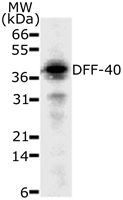
Western blot analysis of 30 µg of HeLa cell lysate with at a dilution of 2 µg/ml.| Product Name | CAD antibody |
|---|---|
| Antibody Type | Primary Antibodies |
| Product description | Mouse monoclonal [36A349] to CADApoptosis is related to many diseases and induced by a family of cell death receptors and their ligands. Cell death signals are transduced by death domain containing adapter molecules and members of the caspase family of proteases. These death signals finally cause the degradation ofchromosomal DNA by activated DNase. A mouse DNase that causes DNA fragmentation was identified recently and designated CAD, which stands for caspase activated deoxyribonuclease. The human homologue of mouse CAD was more recently identified by two groups independently and termed CPAN and DFF40. Human DFF45 and its mouse homologue ICAD are the inhibitors of CPAN/DFF40 and CAD, respectively. Upon cleavage of DFF45/ICAD by activated caspase, DFF40/CAD is released and activated and eventually causes the degradation of DNA in the nuclei. Activation of CAD/DFF40, which causes DNA degradation, is the hallmark of apoptotic cell death. |
| Immunogen | Anti-DFF40 monoclonal antibody was raised against a peptide corresponding to amino acids 205 to 222 (SYFDRGAKGGSRLCTPEG) of human DFF40. |
| Clonality | Monoclonal |
|---|---|
| Isotype | IgG1 |
| Clone Number | 36A349 |
| Host Species | Mouse |
| Tested Applications | WB |
| WB: Use at a concentration of 2 μg/ml. Detects a band of approximately 40 kDa (predicted molecular weight: 41 kDa). Optimal dilutions/concentrations should be determined by the end user.: |
|
| Species Reactivity | HumanMouseRat |
| Concentration | 0.5mg/ml |
| Purification | Protein G |
| Gene Synonyms | P27708 CAD 114010 790 |
|---|---|
| Target | CAD |
| Cellular Localization | Cytoplasmic and Nuclear. |
Application
Western blot analysis of 30 µg of HeLa cell lysate with at a dilution of 2 µg/ml.| Positive Control | HeLa cell lysate |
|---|---|
| Application Notes | WB: Use at a concentration of 2 μg/ml. Detects a band of approximately 40 kDa (predicted molecular weight: 41 kDa). Optimal dilutions/concentrations should be determined by the end user.: |
| Form | Liquid |
|---|---|
| Storage Instructions | Keep as concentrated solution. Store at 4ºC short term. For extended storage aliquot and store at -20ºC or below. Avoid freeze-thaw cycles. |
| Storage Buffer | Preservative: 0.02% Sodium Azide; Constituents: PBS |


