Application
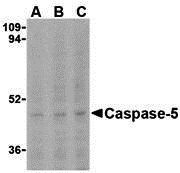
Western blot analysis of Caspase-5 in Ramos cells with Caspase-5 antibody at (A) 0.5, (B) 1, and (C) 2 ug/mL.| Product Name | Caspase 5 antibody |
|---|---|
| Antibody Type | Primary Antibodies |
| Product description | Rabbit Polyclonal antibody to Caspase 5This gene encodes a member of the cysteine-aspartic acid protease (caspase) family. Sequential activation of caspases plays a central role in the execution-phase of cell apoptosis. Caspases exist as inactive proenzymes which undergo proteolytic processing at conserved aspartic residues to produce two subunits, large and small, that dimerize to form the active enzyme. Overexpression of the active form of this enzyme induces apoptosis in fibroblasts. Max, a central component of the Myc/Max/Mad transcription regulation network important for cell growth, differentiation, and apoptosis, is cleaved by this protein; this process requires Fas-mediated dephosphorylation of Max. The expression of this gene is regulated by interferon-gamma and lipopolysaccharide. Alternatively spliced transcript variants have been identified for this gene. [provided by RefSeq, Aug 2010] |
| Immunogen | Caspase-5 antibody was raised against a 16 amino acid synthetic peptide from the amino-terminus of human Caspase-5. |
| Clonality | Polyclonal |
|---|---|
| Isotype | IgG |
| Host Species | Rabbit |
| Tested Applications | ELISAWB |
| WB: 0.5 - 2 ug/ml: |
|
| Species Reactivity | Human |
| Concentration | 1mg/ml (Please refer to the vial label for the specific concentration) |
| Purification | Affinity purified |
| Gene Synonyms | ICE(rel)III ICEREL-III CASP5 caspase 5 apoptosis-related cysteine peptidase ICH-3 |
|---|---|
| Target | Caspase 5 |
| Tissue Specificity | Depending on cell lines or tissues used, other cleavage products may be observed. |
Application
Western blot analysis of Caspase-5 in Ramos cells with Caspase-5 antibody at (A) 0.5, (B) 1, and (C) 2 ug/mL.| Application Notes | WB: 0.5 - 2 ug/ml: |
|---|
| Form | Liquid |
|---|---|
| Storage Instructions | Be stored at 4oC for three months and -20oC, stable for up to one year. As with all antibodies care should be taken to avoid repeated freeze thaw cycles. Antibodies should not be exposed to prolonged high temperatures. |
| Storage Buffer | PBS containing 0.02% sodium azide. |


