Application
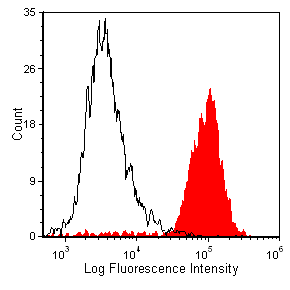
Wistar rat peritoneal macrophages were stained with anti-CD11b/c (clone: OX-42) (filled histogram) or mouse IgG2a isotype control (open histogram).| Product Name | CD11b/c equivalent antibody |
|---|---|
| Antibody Type | Primary Antibodies |
| Product description | Mouse monoclonal [OX 42] to CD11b/c equivalentThe principal use of this antibody is in the study of functional heterogeneity of macrophages; it may be used to follow macrophage differentiation and to investigate the function of the CD11b/c equivalent antigen. |
| Immunogen | Rat macrophages |
| Clonality | Monoclonal |
|---|---|
| Isotype | IgG2a |
| Clone Number | OX 42 |
| Host Species | Mouse |
| Tested Applications | ELISAFACSIAIHC-P |
| ELISA: Use at a dilution of 1/100 - 1/3200. FACS: Use at a dilution of 1/25 - 1/200 (10 μl per million cells). IHC-P: Use at a dilution of 1/25 - 1/200. Optimal dilutions/concentrations should be determined by the end user.: |
|
| Species Reactivity | Rat |
| Concentration | 1mg/ml (Please refer to the vial label for the specific concentration) |
| Gene Synonyms | 25021 MO1A Itgam 3684 MAC1A P11215 CD11B MAC1 CD11b/c equivalent 120980 MAC-1 CR3A MGC117044 MAC 1 |
|---|---|
| Target | CD11b/c equivalent |
| Tissue Specificity | Recognises a common epitope shared by CD11b/c and precipitates three polypeptides of Mw160kD, 103kD and 95kD; a fainter band may also be seen at 133kD. It reacts with all macrophages in the peritoneal cavity, activated macrophages and Kupffer cells, but with only 35% of alveolar macrophages. It also binds to all granulocytes and to dendritic cells, cells with microglial morphology in brain, sparse thymic cortical cells and epidermal Langerhans cells. It inhibits complement mediated rosettes. |
Application
Wistar rat peritoneal macrophages were stained with anti-CD11b/c (clone: OX-42) (filled histogram) or mouse IgG2a isotype control (open histogram).| Application Notes | ELISA: Use at a dilution of 1/100 - 1/3200. FACS: Use at a dilution of 1/25 - 1/200 (10 μl per million cells). IHC-P: Use at a dilution of 1/25 - 1/200. Optimal dilutions/concentrations should be determined by the end user.: |
|---|
| Form | Liquid |
|---|---|
| Storage Instructions | Keep as concentrated solution. Store at 4ºC short term. For extended storage aliquot and store at -20ºC or below. Avoid freeze-thaw cycles. |
| Storage Buffer | Preservative: 0.01% Sodium Azide; Constituents: PBS |


