Application
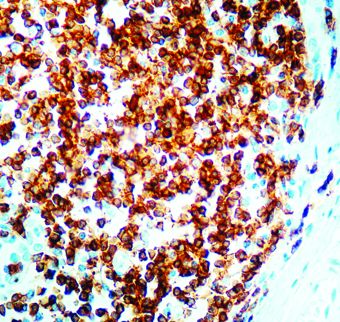
IHC-P analysis of human pituatory tissue using CD3 antibody.Application
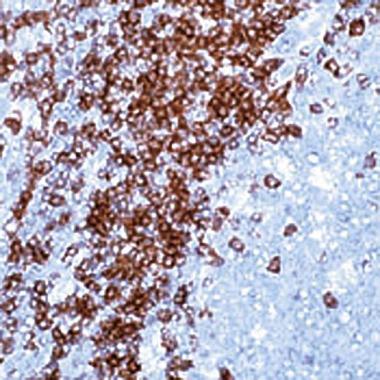
Formalin fixed paraffin embedded human tonsil stained with CD3 antibody| Product Name | CD3 antibody (ready-to-use) |
|---|---|
| Antibody Type | Primary Antibodies |
| Product description | Rabbit polyclonal to CD3 predilutedT cell activation through the antigen receptor (TCR) involves the cytoplasmic tails of the CD3 subunits CD3 gamma, CD3 delta, CD3 epsilon and CD3 zeta. These CD3 subunits are structurally related members of the immunoglobulins super family encoded by closely linked genes on human chromosome 11. The CD3 components have long cytoplasmic tails that associate with cytoplasmic signal transduction molecules. This association is mediated at least in part by a double tyrosine-based motif present in a single copy in the CD3 subunits. CD3 may play a role in TCR-induced growth arrest, cell survival and proliferation. |
| Immunogen | Synthetic peptide (Human) conjugated to BSA. |
| Clonality | Polyclonal |
|---|---|
| Isotype | IgG |
| Host Species | Rabbit |
| Tested Applications | IHC-P |
| IHC-P: Ready to use, suggested incubation period of 30 minutes at room temperature. Optimal dilutions/concentrations should be determined by the end user.: |
|
| Species Reactivity | Human |
| Concentration | 1mg/ml |
| Purification | Protein A |
| Gene Synonyms | T3E 186740 P09693 T3D 916 CD3-GAMMA 917 CD3GAMMA TCRE P20963 186830 186780 P04234 CD3ZETA CD3H CD3Q CD3E CD3 CD3-DELTA TCRZ 919 CD3Z CD3G 915 CD3-ZETA 186790 T3G CD3D P07766 CD3DELTA CD3 ZETA CD3 GAMMA CD3 DELTA |
|---|---|
| Target | CD3 |
| Tissue Specificity | Antibody reacts with intracytoplasmic portion of the CD3 antigen on the T cells. It stains T cells in cortex as well as medulla of the thymus and lymphoid tissues. This antibody also labels T cell neoplasm, malignant histiocytes and in Hodgkin's disease. |
| Cellular Localization | Type I membrane protein. |
Application
IHC-P analysis of human pituatory tissue using CD3 antibody.
Application
Formalin fixed paraffin embedded human tonsil stained with CD3 antibody| Positive Control | Tonsil |
|---|---|
| Application Notes | IHC-P: Ready to use, suggested incubation period of 30 minutes at room temperature. Optimal dilutions/concentrations should be determined by the end user.: |
| Form | Liquid |
|---|---|
| Storage Instructions | Keep as concentrated solution. Store at 4ºC short term. For extended storage aliquot and store at -20ºC or below. Avoid freeze-thaw cycles. |
| Storage Buffer | phosphate buffered saline , pH 7.4, 150mM NaCl, 0.02% sodium azide and 50% glycerol. |


