Application
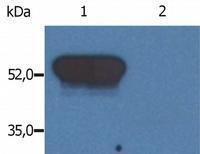
Western Blotting analysis (reducing conditions) of GFAP in porcine brain lysate. Lane 1: immunostaining with anti-GFAP (GF-02). Lane 2: immunostaining with Isotype mouse IgM control (PFR-03)| Product Name | GFAP antibody |
|---|---|
| Antibody Type | Primary Antibodies |
| Product description | Mouse Monoclonal antibody [GF-02] to GFAPGlial Fibrillary Acidic Protein (GFAP) was discovered by Bignami et al. (1972) as a major fibrous protein of multiple sclerosis plaques. It was subsequently found to be a member of the 10 nm or intermediate filament protein family, specifically the intermediate filament protein family Class III, which also includes peripherin, desmin and vimentin. GFAP is heavily, and specifically, expressed in astrocytes and certain other astroglia in the central nervous system, in satellite cells in peripheral ganglia, and in non-myelinating Schwann cells in peripheral nerves. In addition, neural stem cells frequently strongly express GFAP. It is also found in the lens epithelium, Kupffer cells of the liver, in some cells in salivary tumors and has been reported in erythrocytes. Although its function is not fully understood, GFAP protein is probably involved in controlling the shape and movement of astrocytes. The protein probably also plays a significant role in the interactions of astrocytes with other cells, which are required for the formation and maintenance of the insulating layer (myelin) that covers nerve cells. Additionally, GFAP protein may assist in maintaining the protective barrier that allows only certain substances to pass between blood vessels and the brain (blood-brain barrier).In adults, GFAP levels increase as a result of the proliferation of astrocytes that occurs in a response to a variety of physical, chemical and etiological insults, including Alzheimer’s disease, epilepsy and multiple sclerosis.Antibodies to GFAP are therefore very useful as markers of astrocytic cells and neural stem cells and for distinguishing of neoplasms of astrocytic origin from other neoplasms in the central nervous system. Finally, Alexander's disease was recently shown to be caused by point mutations in protein coding region of the GFAP gene (Brenner et al., 2001). All forms of Alexander disease are characterized by the presence of Rosenthal fibers, which are GFAP containing cytoplasmic inclusions found in astrocytes.Entrez Gene (human): 17q21 |
| Immunogen | Pellet of porcine brain cold-stable proteins after depolymerization of microtubules. |
| Clonality | Monoclonal |
|---|---|
| Isotype | IgM |
| Clone Number | GF-02 |
| Host Species | Mouse |
| Tested Applications | ICC/IFIHC-FIHC-PWB |
| Optimal dilutions should be determined experimentally by the researcher.: |
|
| Species Reactivity | HumanPig |
| Concentration | 1mg/ml |
| Gene Synonyms | FLJ45472 |
|---|---|
| Target | GFAP |
| Tissue Specificity | The antibody GF-02 exclusively reacts with intact GFAP molecules. GFAP is the principal marker of astroglial cells in the central nervous system; it is specifically expressed in satellite cells in peripheral ganglia and in non myelinating Schwann cells in peripheral nerves. The GFAP protein runs on gels at ~55 kDa protein, usually associated with lower Mw bands which are thought to be proteolytic fragments and alternate transcripts from the single gene. |
| Cellular Localization | Associated with intermediate filaments. |
Application
Western Blotting analysis (reducing conditions) of GFAP in porcine brain lysate. Lane 1: immunostaining with anti-GFAP (GF-02). Lane 2: immunostaining with Isotype mouse IgM control (PFR-03)| Application Notes | Optimal dilutions should be determined experimentally by the researcher.: |
|---|
| Form | Liquid |
|---|---|
| Storage Instructions | Store at 2-8°C. Do not use after expiration date stamped on vial label. Do not freeze. |
| Storage Buffer | Phosphate buffered saline (PBS) with 15 mM sodium azide, approx. pH 7.4 |


