Application
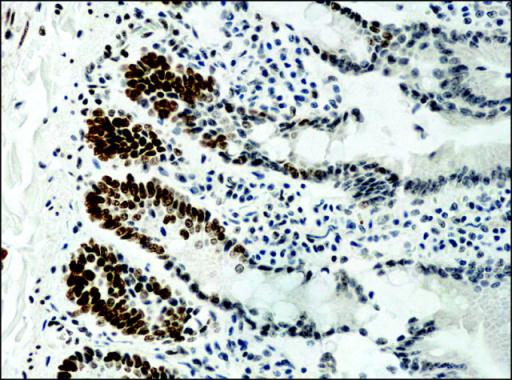
Anti-Acetyl-Histone H3 [Ac-Lys9]: Immunoperoxidase staining of Anti-Acetyl-Histone H3 [Ac-Lys9] in formalin fixed, paraffin-embedded rat liver at 0.1 μg/mL.Application
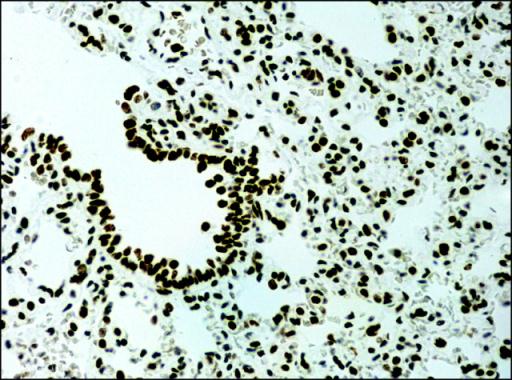
Anti-Acetyl-Histone H3 [Ac-Lys9]: Immunoperoxidase staining of Anti-Acetyl-Histone H3 [Ac-Lys9] in formalin fixed, paraffin-embedded rat lung at 0.1 μg/mL.Application
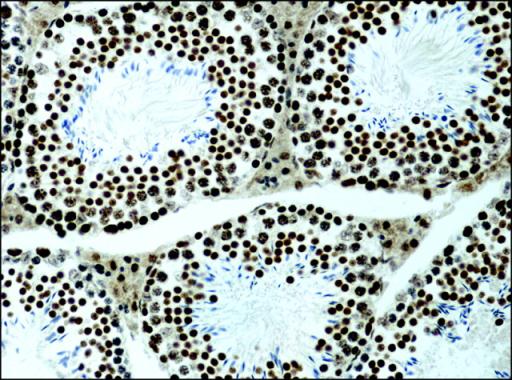
Anti-Acetyl-Histone H3 [Ac-Lys9]: Immunoperoxidase staining of Anti-Acetyl-Histone H3 [Ac-Lys9] in formalin fixed, paraffin-embedded mouse testis at 0.1 μg/mL.Application
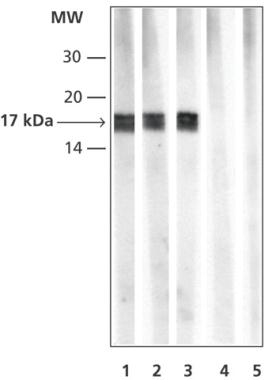
Whole cell extract from serum and sodium butyrate-treated NIH3T3 cells was separated on SDS-PAGE and blotted with Anti-Acetyl-Histone H3 [Ac-Lys9] . The antibodies were developed with Goat Anti-Rabbit IgG-Alkaline phosphatase and BCIP/NBT substrate. Inhibition with the acetylated [Ac-Lys9] histone H3 peptide (Lane 2) with no inhibition with the non-acetyl-histone H3 peptide (Lane 3). Lane 1: Anti-Acetyl-Histone H3 [Ac-Lys9] Lane 2: Anti-Acetyl-Histone H3 [Ac-Lys9] + [Ac-Lys9] histone H3 peptide Lane 3: Anti-Acetyl-Histone H3 [Ac-Lys9] + [non-Ac] histone H3 peptide| Product Name | Histone H3K9ac (acetyl Lys9) antibody |
|---|---|
| Antibody Type | Primary Antibodies |
| Product description | Rabbit polyclonal to Histone H3 ( acetyl K9 )Histone proteins H3, H4, H2A, and H2B function as building blocks to package eukaryotic DNA into repeating nucleosome units that are folded in higher order chromatin fibers. The nucleosome is composed of an octamer containing a H3/H4 tetramer and two H2A/H2B dimers, surrounded by approximately 146 base pairs of DNA. A diverse and elaborate array of post-translational modifications including acetylation, phosphorylation, methylation, ubiquitination, and ADP-ribosylation occurs on the N-terminal tail domains of histones. Acetylation of lysine residues within these N-terminal domains by histone acetyl-transferases (HATs), including Gcn5p, P/CAF, p300/CBP, and TAFII250, is associated with transcriptional activation. This modification results in remodeling of the nucleosome structure into an open conformation more accessible to transcription complexes. Conversely, histone deacetylation by histone deacetylases (HDACs) is associated with transcription repression reversing the chromatin remodeling process. In most species, histone H3 is primarily acetylated at lysine 9, 14, 18, and 23. Acetylation at lysine 9 appears to have a dominant role in histone deposition and chromatin assembly in some organisms. |
| Immunogen | A synthetic acetylated [acetyl K9] histone H3 peptide (amino acids 7-20) corresponding to the N-terminus of human histone H3 conjugated to KLH. |
| Modification | acetyl Lys9 |
| Clonality | Polyclonal |
|---|---|
| Isotype | IgG |
| Host Species | Rabbit |
| Tested Applications | ICC/IFIHC-PWB |
| IF: Use at a dilution of 1/1000. (Determined by indirect immunofluorescence using the NIH3T3 mouse fibroblast cell line treated with sodium butyrate. WB: Use at a dilution of 1/1000. Detects a band of approximately 17 kDa. (Determined by immunoblotting using a using a whole cell extract of the mouse fibroblast NIH3T3 cell line treated with sodium butyrate.) Optimal dilutions/concentrations should be determined by the end user. We advise you to centrifuge this product vial before use.: |
|
| Species Reactivity | HumanMouseRatXenopusBovine |
| Concentration | 1mg/ml |
| Purification | Affinity purified |
| Gene Synonyms | 601128 P84243 Q66I33 3021 Histone H3 MGC87783 H3.3A H3F3 601058 H3F3A MGC87782 H3.3B 3020 H3F3B Histone H3 (acetyl K9) Histone H3 (acetyl Lys9) Histone H3 acetyl K9 Histone H3 acetyl Lys9 Acetyl Histone H3 (K9) Acetyl Histone H3 (Lys9) |
|---|---|
| Target | Histone H3 |
| Tissue Specificity | Staining of (acetyl K9) histone H3 in immunoblotting is specifically inhibited with the immunizing peptide. There is no inhibition with non-acetylated histone H3 peptide. |
| Cellular Localization | Nuclear |
Application
Anti-Acetyl-Histone H3 [Ac-Lys9]: Immunoperoxidase staining of Anti-Acetyl-Histone H3 [Ac-Lys9] in formalin fixed, paraffin-embedded rat liver at 0.1 μg/mL.
Application
Anti-Acetyl-Histone H3 [Ac-Lys9]: Immunoperoxidase staining of Anti-Acetyl-Histone H3 [Ac-Lys9] in formalin fixed, paraffin-embedded rat lung at 0.1 μg/mL.
Application
Anti-Acetyl-Histone H3 [Ac-Lys9]: Immunoperoxidase staining of Anti-Acetyl-Histone H3 [Ac-Lys9] in formalin fixed, paraffin-embedded mouse testis at 0.1 μg/mL.
Application
Whole cell extract from serum and sodium butyrate-treated NIH3T3 cells was separated on SDS-PAGE and blotted with Anti-Acetyl-Histone H3 [Ac-Lys9] . The antibodies were developed with Goat Anti-Rabbit IgG-Alkaline phosphatase and BCIP/NBT substrate. Inhibition with the acetylated [Ac-Lys9] histone H3 peptide (Lane 2) with no inhibition with the non-acetyl-histone H3 peptide (Lane 3). Lane 1: Anti-Acetyl-Histone H3 [Ac-Lys9] Lane 2: Anti-Acetyl-Histone H3 [Ac-Lys9] + [Ac-Lys9] histone H3 peptide Lane 3: Anti-Acetyl-Histone H3 [Ac-Lys9] + [non-Ac] histone H3 peptide| Application Notes | IF: Use at a dilution of 1/1000. (Determined by indirect immunofluorescence using the NIH3T3 mouse fibroblast cell line treated with sodium butyrate. WB: Use at a dilution of 1/1000. Detects a band of approximately 17 kDa. (Determined by immunoblotting using a using a whole cell extract of the mouse fibroblast NIH3T3 cell line treated with sodium butyrate.) Optimal dilutions/concentrations should be determined by the end user. We advise you to centrifuge this product vial before use.: |
|---|
| Form | Liquid |
|---|---|
| Storage Instructions | Keep as concentrated solution. Store at 4ºC short term. For extended storage aliquot and store at -20ºC or below. Avoid freeze-thaw cycles. |
| Storage Buffer | Preservative: 15mM Sodium Azide; Constituents: 0.01M PBS. pH 7.4 |


