Application
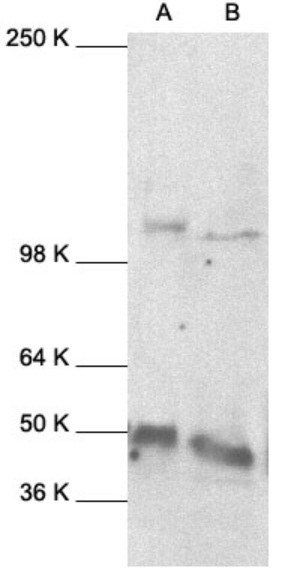
Western Blot analysis of NFkB p50 expression in HeLa (A), HL-60 (B), and NIH/3T3 (C) whole cell lysates.| Product Name | NFkB p105/p50 antibody |
|---|---|
| Antibody Type | Primary Antibodies |
| Product description | Rabbit polyclonal antibody to NFkB p50In resting cells, NFkB is retained in the cytoplasm bound to inhibitory proteins of the IkB family. Degradation of IkB proteins occurs with cell activation, via of variety of signals, including inflammatory cytokines and bacterial lipopolysaccharides (LPS) as well as oxidative and fluid mechanical stress. This results in nuclear translocation of NFkB and the transcriptional gene activation of pro-inflammatory genes (1,9). NFkB plays a role in the development of numerous pathological states. Activation of NFkB induces gene programs leading to transcription of factors that promote inflammation, such as leukocyte adhesion molecules, cytokines, and chemokines. It is also thought that there are some substances with possible anti-inflammatory effects that are also NFkappaB regulated. There is some evidence indicating NFkB as a key factor in the pathophysiology of cardiac ischemia-reperfusion injury as well as the development of insulin dependent Diabetes Mellitus (3-4). |
| Immunogen | Synthetic peptide mapping to the carboxy terminal domain of human NFkB p50. |
| Clonality | Polyclonal |
|---|---|
| Isotype | IgG |
| Host Species | Rabbit |
| Tested Applications | IHCIPWB |
| For IHC: Use at an assay dependent dilution. For IP: Use at an assay dependent dilution. For WB: Use at a dilution of 1:400. Optimal dilutions/concentrations should be determined by the researcher.: |
|
| Species Reactivity | HumanMouseRat |
| Concentration | 0.2mg/ml |
| Gene Synonyms | DKFZp686C01211 EBP-1 KBF1 MGC54151 NF-kappa-B NF-kappaB NFKB-p105 NFKB-p50 p105 p50 EBP 1 NFKB p50 NF kappaB NFKB p105 NF kappa B EBP1 NFKBp50 NFkappaB NFKBp105 |
|---|---|
| Target | NFkB p105/p50 |
| Tissue Specificity | NFkB p50 (C20) DB035 reacts with NFkB p50 and p105 of mouse, rat, and human origin. |
Application
Western Blot analysis of NFkB p50 expression in HeLa (A), HL-60 (B), and NIH/3T3 (C) whole cell lysates.| Application Notes | For IHC: Use at an assay dependent dilution. For IP: Use at an assay dependent dilution. For WB: Use at a dilution of 1:400. Optimal dilutions/concentrations should be determined by the researcher.: |
|---|
| Form | Liquid |
|---|---|
| Storage Instructions | Keep as concentrated solution, aliquot and store at 4°C. Do not freeze. |
| Storage Buffer | Phosphate-buffered saline containing 0.1% sodium azide and 0.2% gelatin |


