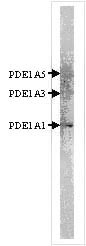
Application
Western Blot using (1:500)| Product Name | PDE1A antibody |
|---|---|
| Antibody Type | Primary Antibodies |
| Product description | Rabbit polyclonal to PDE1ACyclic nucleotides are hydrolyzed and compartmentalized by a family of enzymes called phosphodieterases. In mammals at least 11 different families of PDEs can be discriminated (PDE1-11) based on their kinetic properties and inhibition to various pharmacological agents. Three different PDE1 genes have been identified (PDE1A, B, and C). PDE1A and PDE1B have higher affinity for cGMP than for cAMP, whereas PDE1C has high affinity for both cAMP and cGMP. The PDE1A gene family includes various proteins that differ from each other at amino and carboxy termini of the protein. There are three novel PDE1A variants so far identified (PDE1A1; PDE1A3 and PD1A5), PDE1A5 encodes a 519 residue protein , which is different from PDE1A1 by insertion of 14 amino acid residues at the carboxy terminal and is also different from PDE1A3 by a divergent at N-terminus. The tissue distribution of PDE1A is different from other PDE1 gene family members. In testis PDE1A is highly expressed but in different stages of developing germ cells. |
| Immunogen | Synthetic peptides (conserved sequence near the N-terminal) unique to PDE1A family members. |
| Clonality | Polyclonal |
|---|---|
| Isotype | IgG |
| Host Species | Rabbit |
| Tested Applications | IPWB |
| IP: Use at a dilution of 1/200. WB: Use at a dilution of 1/250 - 1/500. Predicted molecular weight: 61 kDa. This antibody labels multiple bands in 65-72 kDa range all believed to be various PDE1A variants expressed in various rat tissues. Optimal dilutions/concentrations should be determined by the end user.: |
|
| Species Reactivity | HumanMouseRat |
| Concentration | 1mg/ml |
| Purification | Affinity purified |
| Gene Synonyms | HSPDE1A MGC26303 171890 HCAM1 5136 PDE1A P54750 |
|---|---|
| Target | PDE1A |
Application
Western Blot using (1:500)| Positive Control | Rat testis |
|---|---|
| Application Notes | IP: Use at a dilution of 1/200. WB: Use at a dilution of 1/250 - 1/500. Predicted molecular weight: 61 kDa. This antibody labels multiple bands in 65-72 kDa range all believed to be various PDE1A variants expressed in various rat tissues. Optimal dilutions/concentrations should be determined by the end user.: |
| Form | Liquid |
|---|---|
| Storage Instructions | Keep as concentrated solution. Store at 4ºC short term. For extended storage aliquot and store at -20ºC or below. Avoid freeze-thaw cycles. |
| Storage Buffer | phosphate buffered saline , pH 7.4, 150mM NaCl, 0.02% sodium azide and 50% glycerol. |


