Application
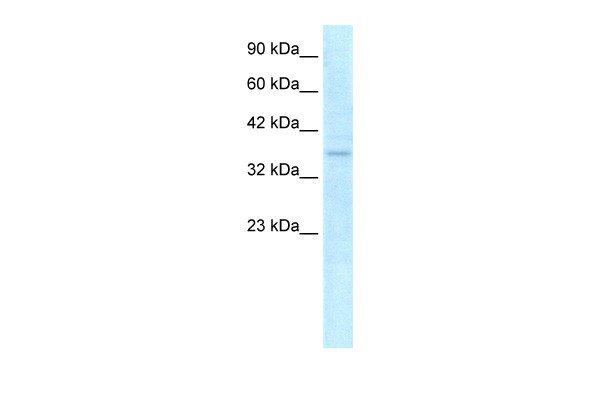
Antibody used in WB on Human HepG2 at 0.2-1 ug/ml.Application
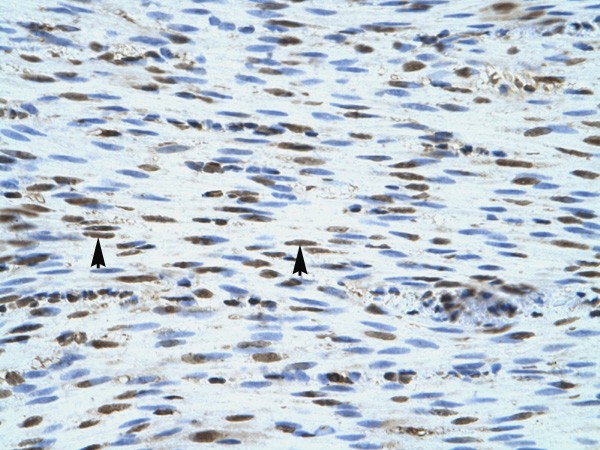
Antibody used in IHC on Human Smooth Muscle.| Product Name | CARD12 Antibody |
|---|---|
| Antibody Type | Primary Antibodies |
| Product description | In C. elegans, Ced4 binds and activates Ced3, an apoptotic initiator caspase, via caspase-associated recruitment domains (CARDs). Human Ced4 homologs include APAF1, NOD1, and NOD2. These proteins have at least 1 N-terminal CARD domain followed by a centrally located nucleotide-binding domain (NBD or NACHT) and a C-terminal regulatory domain, found only in mammals, that contains either WD40 repeats or leucine-rich repeats (LRRs). CARD12 is a member of the Ced4 family and can induce apoptosis.1) Clark, H.F., et al., (2003) Genome Res. 13 (10), 2265-2270. |
| Immunogen | Antibody produced in rabbits immunized with a synthetic peptide corresponding a region of human CARD12. |
| Clonality | Polyclonal |
|---|---|
| Host Species | Rabbit |
| Tested Applications | ELISAIHCWB |
| CARD12 antibody can be used for detection of CARD12 by ELISA at 1:62500. CARD12 antibody can be used for detection of CARD12 by western blot at 1.0 μg/mL, and HRP conjugated secondary antibody should be diluted 1:50,000 - 100,000.: |
|
| Species Reactivity | Human |
| Concentration | 1mg/ml |
| Purification | Affinity purified |
| Gene Symbol | NLRC4 |
|---|---|
| Alternative Names | CARD12 CLAN IPAF CLAN1 CLANA CLANB CLANC CLAND CARD12 CLR2.1 |
| Molecular Weight(MW) | 116 kDa |
Application
Antibody used in WB on Human HepG2 at 0.2-1 ug/ml.
Application
Antibody used in IHC on Human Smooth Muscle.| Application Notes | CARD12 antibody can be used for detection of CARD12 by ELISA at 1:62500. CARD12 antibody can be used for detection of CARD12 by western blot at 1.0 μg/mL, and HRP conjugated secondary antibody should be diluted 1:50,000 - 100,000.: |
|---|
| Form | Liquid |
|---|---|
| Storage Instructions | For short periods of storage (days) store at 4˚C. For longer periods of storage, store CARD12 antibody at -20˚C. As with any antibody avoid repeat freeze-thaw cycles. |
| Storage Buffer | Antibody is lyophilized in PBS buffer with 2% sucrose. Add 50 μL of distilled water. Final antibody concentration is 1 mg/mL. |


