Application
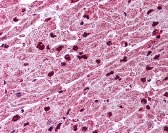
Immunohistochemistry staining of Caspase-4 in heart tissue using Caspase-4 Antibody.| Product Name | Caspase-4 Antibody |
|---|---|
| Antibody Type | Primary Antibodies |
| Antigen Alias | CASP4, CASP-4, Casp11, Caspase 4, Caspase-4, Cysteine protease icerel-ii, ICE(rel)-II, ICE(rel)II, ICH-2, Ich-3, ICH2, Protease ICH-2, TX, Tx protease, Caspase 11, ICEREL-II, Mih1/TX, Protease TX |
| Product description | Caspases are a family of cysteine proteases that can be divided into the apoptotic and inflammatory caspase subfamilies. Unlike the apoptotic caspases, members of the inflammatory subfamily are generally not involved in cell death but are associated with the immune response to microbial pathogens. Members of this subfamily include caspase-1, -4, -5, and -12. Activation of these caspases results in the cleavage and activation of proinflammatory cytokines such as IL-1b and IL-18. Caspase-4 was initially identified as a homologous protein to Caspase-1 and the C. elegans Ced-3 which could induce apoptosis in transfected cells. More recent studies have shown that it can be activated by ER stress and has been suggested to be involved in multiple neuronal pathologies such as Alzheimer’s disease. The rodent homolog is known as Caspase 4 and Caspase 11. |
| Immunogen | Synthetic peptide from human CASP4 / Caspase 4. |
| Clonality | Polyclonal |
|---|---|
| Host Species | Rabbit |
| Tested Applications | IHCWB |
| Caspase-4 antibody can be used in ELISA, Western Blot starting at 1:500 - 1:1000, immunohistochemistry starting at 5 μg/mL, and immunofluorescence starting at 10 μg/mL.: |
|
| Species Reactivity | HumanMouse |
| Concentration | 1mg/ml |
| Purification | Affinity purified |
| Gene Symbol | CASP4 |
|---|---|
| Alternative Names | CASP4 CASP-4 Casp11 Caspase 4 Caspase-4 Cysteine protease icerel-ii ICE(rel)-II ICE(rel)II ICH-2 Ich-3 ICH2 Protease ICH-2 TX Tx protease Caspase 11 ICEREL-II Mih1/TX Protease TX |
Application
Immunohistochemistry staining of Caspase-4 in heart tissue using Caspase-4 Antibody.| Application Notes | Caspase-4 antibody can be used in ELISA, Western Blot starting at 1:500 - 1:1000, immunohistochemistry starting at 5 μg/mL, and immunofluorescence starting at 10 μg/mL.: |
|---|
| Form | Liquid |
|---|---|
| Storage Instructions | Aliquot and store Caspase-4 antibody at -20 ˚C. As with all antibodies avoid freeze/thaw cycles. |
| Storage Buffer | PBS, 0.02% sodium azide. |


