Application
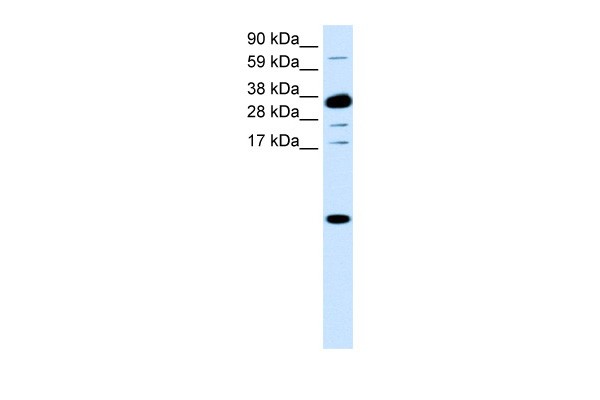
Antibody used in WB on Human Small Intestine at 0.0758 ug/ml.| Product Name | CXCL1 Antibody |
|---|---|
| Antibody Type | Primary Antibodies |
| Antigen Alias | CXCL1, GRO1, GROa, MGSA, MGSA alpha, MGSA-a, NAP-3, SCYB1, FSP |
| Product description | Chemokines are a group of small (approximately 8 to 14 kD), mostly basic, structurally related molecules that regulate cell trafficking of various types of leukocytes through interactions with a subset of 7-transmembrane, G protein-coupled receptors. Chemokines also play fundamental roles in the development, homeostasis, and function of the immune system, and they have effects on cells of the central nervous system as well as on endothelial cells involved in angiogenesis or angiostasis. Chemokines are divided into 2 major subfamilies, CXC and CC, based on the arrangement of the first 2 of the 4 conserved cysteine residues; the 2 cysteines are separated by a single amino acid in CXC chemokines and are adjacent in CC chemokines. CXC chemokines are further subdivided into ELR and non-ELR types based on the presence or absence of a glu-leu-arg sequence adjacent and N terminal to the CXC motif.Chemokines are a group of small (approximately 8 to 14 kD), mostly basic, structurally related molecules that regulate cell trafficking of various types of leukocytes through interactions with a subset of 7-transmembrane, G protein-coupled receptors. Chemokines also play fundamental roles in the development, homeostasis, and function of the immune system, and they have effects on cells of the central nervous system as well as on endothelial cells involved in angiogenesis or angiostasis. Chemokines are divided into 2 major subfamilies, CXC and CC, based on the arrangement of the first 2 of the 4 conserved cysteine residues; the 2 cysteines are separated by a single amino acid in CXC chemokines and are adjacent in CC chemokines. CXC chemokines are further subdivided into ELR and non-ELR types based on the presence or absence of a glu-leu-arg sequence adjacent and N terminal to the CXC motif.[supplied by OMIM]. Publication Note: This RefSeq record includes a subset of the publications that are available for this gene. Please see the Entrez Gene record to access additional publications.1) Breland, U.M., (2008) Arterioscler. Thromb. Vasc. Biol. 28 (5), 1005-1011. |
| Immunogen | Antibody produced in rabbits immunized with a synthetic peptide corresponding a region of human CXCL1. |
| Clonality | Polyclonal |
|---|---|
| Host Species | Rabbit |
| Tested Applications | ELISAWB |
| CXCL1 antibody can be used for detection of CXCL1 by ELISA at 1:312500. CXCL1 antibody can be used for detection of CXCL1 by western blot at 1 μg/mL, and HRP conjugated secondary antibody should be diluted 1:50,000 - 100,000.: |
|
| Species Reactivity | Human |
| Concentration | 1mg/ml |
| Purification | Affinity purified |
| Gene Symbol | CXCL1 |
|---|---|
| Alternative Names | CXCL1 GRO1 GROa MGSA MGSA alpha MGSA-a NAP-3 SCYB1 FSP |
| Molecular Weight(MW) | 8 kDa |
Application
Antibody used in WB on Human Small Intestine at 0.0758 ug/ml.| Positive Control | 1) Cat. No. XBL-10420 - Fetal Small Intestine Tissue Lysate |
|---|---|
| Application Notes | CXCL1 antibody can be used for detection of CXCL1 by ELISA at 1:312500. CXCL1 antibody can be used for detection of CXCL1 by western blot at 1 μg/mL, and HRP conjugated secondary antibody should be diluted 1:50,000 - 100,000.: |
| Form | Liquid |
|---|---|
| Storage Instructions | For short periods of storage (days) store at 4˚C. For longer periods of storage, store CXCL1 antibody at -20˚C. As with any antibody avoid repeat freeze-thaw cycles. |
| Storage Buffer | Antibody is lyophilized in PBS buffer with 2% sucrose. Add 50 μL of distilled water. Final antibody concentration is 1 mg/mL. |


