Application
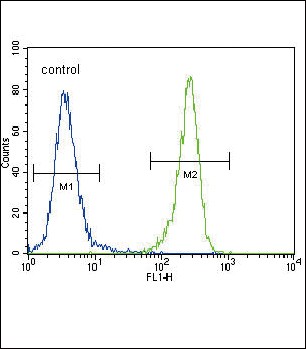
Flow cytometric analysis of 293 cells (right histogram) compared to a negative control cell (left histogram).FITC-conjugated goat-anti-rabbit secondary antibodies were used for the analysis.| Product Name | DDR1 Antibody |
|---|---|
| Antibody Type | Primary Antibodies |
| Antigen Alias | Epithelial discoidin domain-containing receptor 1, Epithelial discoidin domain receptor 1, CD167 antigen-like family member A, Cell adhesion kinase, Discoidin receptor tyrosine kinase, HGK2, Mammary carcinoma kinase 10, MCK-10, Protein-tyrosine kinase 3A, |
| Product description | Receptor tyrosine kinases (RTKs) play a key role in the communication of cells with their microenvironment. These molecules are involved in the regulation of cell growth, differentiation and metabolism. DDR1 is an RTK that is widely expressed in normal and transformed epithelial cells and is activated by various types of collagen. It belongs to a subfamily of tyrosine kinase receptors with a homology region to the Dictyostelium discoideum protein discoidin I in their extracellular domain. Its autophosphorylation is achieved by all collagens so far tested (type I to type VI). In situ studies and Northern-blot analysis show that expression of DDR1 is restricted to epithelial cells, particularly in the kidney, lung, gastrointestinal tract, and brain. In addition, it is significantly over-expressed in several human tumors from breast, ovarian, esophageal, and pediatric brain.1) Johnson J.D.,Proc. Natl. Acad. Sci. U.S.A. 90:5677-5681(1993) |
| Immunogen | This DDR1 antibody is generated from rabbits immunized with a KLH conjugated synthetic peptide between 299-330 amino acids from the Central region of human DDR1. |
| Clonality | Polyclonal |
|---|---|
| Isotype | Ig |
| Host Species | Rabbit |
| Tested Applications | IFIHC-PWB |
| For WB starting dilution is: 1:1000 For IHC-P starting dilution is: 1:10~50 For IF starting dilution is: 1:10~50 For FACS starting dilution is: 1:10~50: |
|
| Species Reactivity | Human |
| Concentration | 1mg/ml |
| Gene Symbol | DDR1 |
|---|---|
| Alternative Names | Epithelial discoidin domain-containing receptor 1 Epithelial discoidin domain receptor 1 CD167 antigen-like family member A Cell adhesion kinase Discoidin receptor tyrosine kinase HGK2 Mammary carcinoma kinase 10 MCK-10 Protein-tyrosine kinase 3A |
| Molecular Weight(MW) | 101 kDa |
Application
Flow cytometric analysis of 293 cells (right histogram) compared to a negative control cell (left histogram).FITC-conjugated goat-anti-rabbit secondary antibodies were used for the analysis.| Application Notes | For WB starting dilution is: 1:1000 For IHC-P starting dilution is: 1:10~50 For IF starting dilution is: 1:10~50 For FACS starting dilution is: 1:10~50: |
|---|
| Form | Liquid |
|---|---|
| Storage Instructions | Store at 4˚C for three months and -20˚C, stable for up to one year. As with all antibodies care should be taken to avoid repeated freeze thaw cycles. Antibodies should not be exposed to prolonged high temperatures. |
| Storage Buffer | Supplied in PBS with 0.09% (W/V) sodium azide. |


