Application
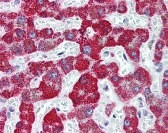
Immunohistochemistry staining of FANCD2 in liver tissue using FANCD2 monoclonal Antibody.| Product Name | FANCD2 Antibody [103] |
|---|---|
| Antibody Type | Primary Antibodies |
| Product description | Fanconi Anemia Complementation Group D2 (FANCD2) protein is one of at least six factors shown to be involved in the autosomal-recessive cancer-prone disorder, Fanconi Anemia (FA). FA group D has been shown to be comprised of two separate proteins, FANCD1 and FANCD2. Mutations in BRCA2 can cause FANCD1. FANCD2 has been shown to colocalize with BRCA1 in ionizing radiation-induced foci. FANCD2 is involved in genomic resistance to DNA cross-linking reagents, and the arrest of DNA synthesis following exposure to ionizing radiation. FANCD2 has been shown to directly interact with NBS1. FANCD2 is one of at least four different genes, of which when mutated can cause the Fanconi anemia phenotype characterized by congenital defects, progressive bone marrow failure, and cellular hypersensitivity to mitomcyin C. FANCD2 is phosphorylated by ATM following ionizing radiation and this phosphorylation is required for activation of an S-phase checkpoint. It is also monoubiquitinated in response to DNA damage. It is postulated that FANCD2 may have a role in the cellular response to stalled replication forks or in the repair of replication-associated double-strand breaks. |
| Immunogen | FANCD2 monoclonal antibody was raised against full length FANCD2 (Human). |
| Clonality | Monoclonal |
|---|---|
| Isotype | IgG |
| Host Species | Mouse |
| Tested Applications | ELISAIHCWB |
| FANCD2 antibody can be used in immunohistochemistry starting at 5.6 μg/mL. | |
| Species Reactivity | Human |
| Concentration | 1mg/ml |
| Purification | Protein G |
| Gene Symbol | FANCD2 |
|---|---|
| Alternative Names | FANCD2 FA-D2 FAD FACD FA4 FAD2 FANCD Protein FACD2 |
Application
Immunohistochemistry staining of FANCD2 in liver tissue using FANCD2 monoclonal Antibody.| Application Notes | FANCD2 antibody can be used in immunohistochemistry starting at 5.6 μg/mL. |
|---|
| Form | Liquid |
|---|---|
| Storage Instructions | Store FANCD2 antibody at -20 ˚C. As with all antibodies avoid freeze/thaw cycles. |
| Storage Buffer | PBS, pH 7.2, Contains no preservative. |


