Application
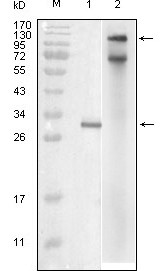
Western blot analysis using IKBKE monoclonal antibody against truncated IKBKE monoclonal antibody against turncated IKBKE - His recombinant protein and full length IKBKE (aa1 - 716) - hIgGFc transfected COS7 lysate.| Product Name | IKBKE Antibody |
|---|---|
| Antibody Type | Primary Antibodies |
| Antigen Alias | IKKE, IKKI, KIAA0151, Inducible I kappa-B kinase, I-kappa-B kinase epsilon, IKKE, IKK-E, IKK-i |
| Product description | Inhibitor of kappa light polypeptide gene enhancer in B-cells, kinase epsilon.The transcription factor NFκB is retained in the cytoplasm in an inactive form by the inhibitory protein IκB. Activation of NFκB requires that IκB be phosphorylated on specific serine residues, which results in targeted degra-dation of IκB. IκB kinase α(IKKα), previously designated CHUK, interacts with IκB-αand specifically phosphorylates IκB-αon the sites that trigger its degradation, serines 32 and 36. The functional IKK complex contains three subunits, IKKα, IKKβand IKKγ(also designated NEMO), and each appear to make essential contributions to IκB phosphorylation. IKK-i is a serine/threonine kinase that shares homology with IKKαand IKKβ. IKK-i is pri-marily expressed in immune cells and is induced by lipopolysaccharide and by proinflammatory cytokines including TNFα, IL-1 and IL-6. Overexpression of IKK-i was shown to result in phosphorylation of IκBαon Ser32 and Ser36, and in NFκB activation, suggesting that IKK-i may act as an IκB kinase in the immune system.1) Cell. 2007 Jun 15;129(6):1065-79. |
| Immunogen | Purified truncated recombinant IKBKE-His (aa1-257) is expressed in E. Coli strain BL21 (DE3). |
| Clonality | Monoclonal |
|---|---|
| Isotype | IgG1 |
| Host Species | Mouse |
| Tested Applications | ELISAWB |
| Western Blot:1:500 - 1:2,000 ELISA:Propose dilution 1:10,000. Determining optimal working dilutions by titration test.: |
|
| Species Reactivity | Human |
| Concentration | 1mg/ml |
| Gene Symbol | IKBKE |
|---|---|
| Alternative Names | IKKE IKKI KIAA0151 Inducible I kappa-B kinase I-kappa-B kinase epsilon IKKE IKK-E IKK-i |
Application
Western blot analysis using IKBKE monoclonal antibody against truncated IKBKE monoclonal antibody against turncated IKBKE - His recombinant protein and full length IKBKE (aa1 - 716) - hIgGFc transfected COS7 lysate.| Application Notes | Western Blot:1:500 - 1:2,000 ELISA:Propose dilution 1:10,000. Determining optimal working dilutions by titration test.: |
|---|
| Form | Liquid |
|---|---|
| Storage Instructions | IKBKE monoclonal antibody can be stored at -20˚C, stable for one year. As with all antibodies care should be taken to avoid repeated freeze thaw cycles. Antibodies should not be exposed to prolonged high temperatures. |
| Storage Buffer | phosphate buffered saline , pH 7.4, 150mM NaCl, 0.02% sodium azide and 50% glycerol. |


