Application
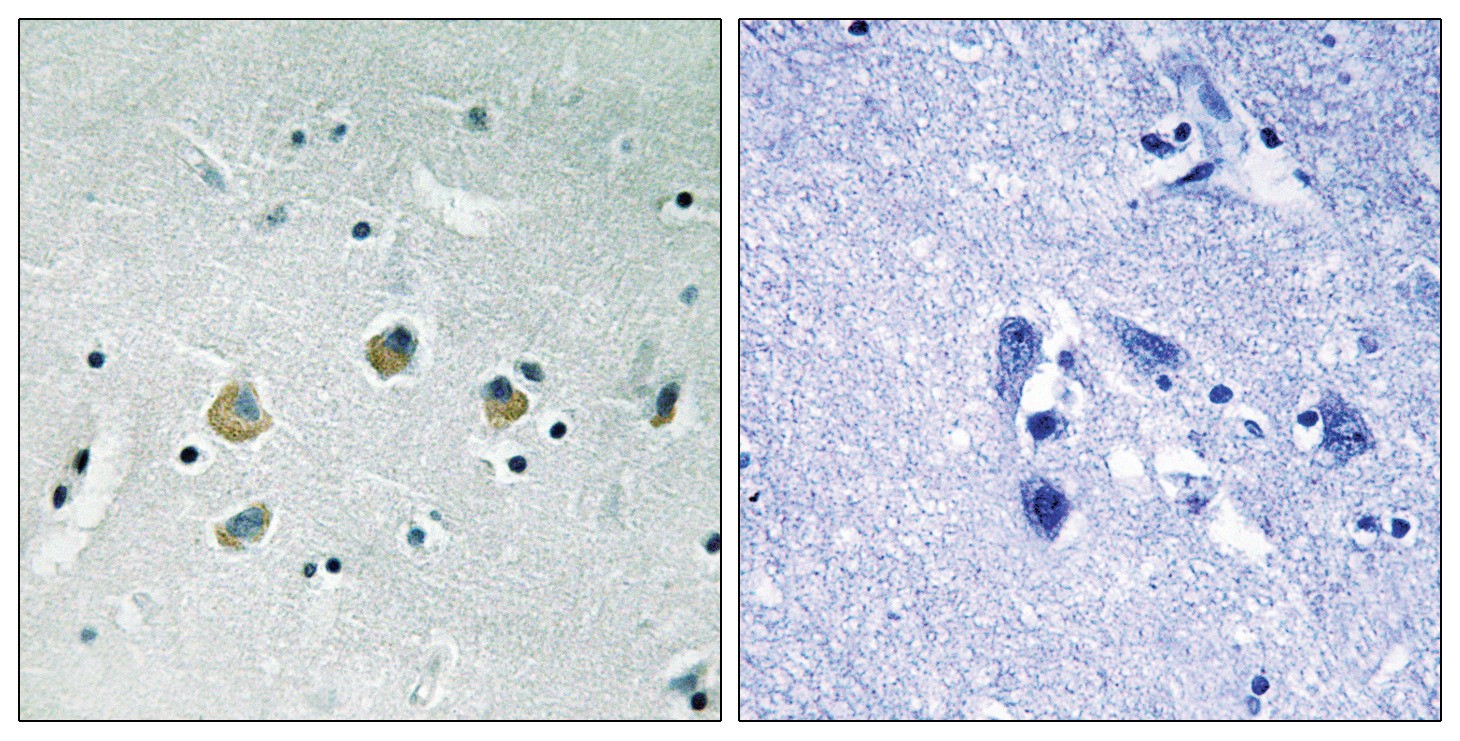
Immunohistochemical analysis of paraffin-embedded human brain tissue using MAP3K8 (Phospho-Ser400) antibody (left) or the same antibody preincubated with blocking peptide (right).| Product Name | MAP3K8 (phospho Ser400) Antibody |
|---|---|
| Antibody Type | Primary Antibodies |
| Antigen Alias | C-COT;, M3K8, MAP3K8, TPL2 |
| Product description | This gene was identified by its oncogenic transforming activity in cells. The encoded protein is a member of the serine/threonine protein kinase family. This kinase can activate both the MAP kinase and JNK kinase pathways. This kinase was shown to activate IkappaB kinases, and thus induce the nuclear production of NF-kappaB. This kinase was also found to promote the production of TNF-alpha and IL-2 during T lymphocyte activation. Studies of a similar gene in rat suggested the direct involvement of this kinase in the proteolysis of NF-kappaB1,p105 (NFKB1).1) Miyoshi J., Mol. Cell. Biol. 11:4088-4096(1991). |
| Immunogen | MAP3K8 (phospho Ser400) antibody was raised against a peptide sequence around phosphorylation site of Serine 400 (C-Q-S (p)-L-D) derived from HumanMAP3K8. |
| Modification | p-Ser400 |
| Clonality | Polyclonal |
|---|---|
| Isotype | IgG |
| Host Species | Rabbit |
| Tested Applications | IHC |
| IHC:1:50~1:200 Notes:Optimal dilutions/concentrations should be determined by the researcher. |
|
| Species Reactivity | HumanMouseRat |
| Concentration | 1mg/ml |
| Purification | Affinity purified |
| Gene Symbol | MAP3K8 |
|---|---|
| Alternative Names | C-COT M3K8 MAP3K8 TPL2 |
| Molecular Weight(MW) | 52 kDa |
| Tissue Specificity | The antibody detects endogenous levels of MAP3K8 only when phosphorylated at serine 400. |
| Entrez Gene | 1326 |
|---|---|
| Protein Accession | NP_001231063.1 |
Application
Immunohistochemical analysis of paraffin-embedded human brain tissue using MAP3K8 (Phospho-Ser400) antibody (left) or the same antibody preincubated with blocking peptide (right).| Application Notes | IHC:1:50~1:200 Notes:Optimal dilutions/concentrations should be determined by the researcher. |
|---|
| Form | Liquid |
|---|---|
| Storage Instructions | Store antibody at -20˚C for up to one year. |
| Storage Buffer | Antibody supplied in phosphate buffered saline (without Mg2+ and Ca2+), pH 7.4, 150mM NaCl, 0.02% sodium azide and 50% glycerol. |


