Application
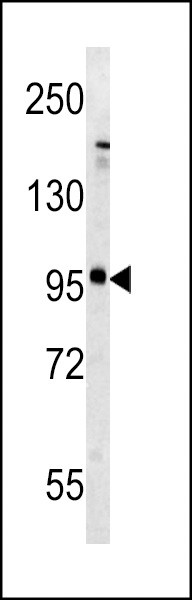
Western blot analysis of Metabotropic Glutamate Receptor 5 (GPRC1E) antibody (C-term T1003) in mouse brain tissue lysates (35ug/lane).| Product Name | Metabotropic Glutamate Receptor 5 Antibody |
|---|---|
| Antibody Type | Primary Antibodies |
| Product description | L-glutamate is the major excitatory neurotransmitter in the central nervous system and activates both ionotropic and metabotropic glutamate receptors. Glutamatergic neurotransmission is involved in most aspects of normal brain function and can be perturbed in many neuropathologic conditions. The metabotropic glutamate receptors are a family of G protein-coupled receptors, that have been divided into 3 groups on the basis of sequence homology, putative signal transduction mechanisms, and pharmacologic properties. Group I includes GRM1 and GRM5 (also known as GPRC1E) and these receptors have been shown to activate phospholipase C. Group II includes GRM2 and GRM3 while Group III includes GRM4, GRM6, GRM7 and GRM8. Group II and III receptors are linked to the inhibition of the cyclic AMP cascade but differ in their agonist selectivities. The activity of GRM5 is mediated by a G-protein that activates a phosphatidylinositol-calcium second messenger system and generates a calcium-activated chloride current.1) Pacheco, R., et al., J. Biol. Chem. 279(32):33352-33358 (2004). |
| Immunogen | This Metabotropic Glutamate Receptor 5 (GPRC1E) antibody is generated from rabbits immunized with a KLH conjugated synthetic peptide between 1020-1050 amino acids from the C-terminal region of human Metabotropic Glutamate Receptor 5 (GPRC1E). |
| Clonality | Polyclonal |
|---|---|
| Isotype | Ig |
| Host Species | Rabbit |
| Tested Applications | WB |
| For WB starting dilution is: 1:1000 | |
| Species Reactivity | HumanMouse |
| Concentration | 1mg/ml |
| Purification | Unpurified |
| Gene Symbol | GRM5 |
|---|---|
| Alternative Names | Metabotropic glutamate receptor 5 mGluR5 GRM5 GPRC1E MGLUR5 |
| Molecular Weight(MW) | 132 kDa |
Application
Western blot analysis of Metabotropic Glutamate Receptor 5 (GPRC1E) antibody (C-term T1003) in mouse brain tissue lysates (35ug/lane).| Application Notes | For WB starting dilution is: 1:1000 |
|---|
| Form | Liquid |
|---|---|
| Storage Instructions | Store at 4˚C for three months and -20˚C, stable for up to one year. As with all antibodies care should be taken to avoid repeated freeze thaw cycles. Antibodies should not be exposed to prolonged high temperatures. |
| Storage Buffer | Supplied in PBS with 0.09% (W/V) sodium azide. |


