Application
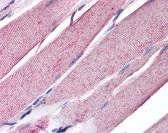
Immunohistochemistry staining of Myogenin in skeletal muscle tissue using Myogenin monoclonal Antibody.| Product Name | Myogenin Antibody [5FD] |
|---|---|
| Antibody Type | Primary Antibodies |
| Product description | Myogenin is a member of the MyoD family of myogenic basic helix-loop-helix (bHLH) transcription factors that also includes MyoD, Myf-5, and MRF4 (also known as herculinor Myf-6). MyoD family members are expressed exclusively in skeletal muscle and play a key role in activating myogenesis by binding to enhancer sequences of muscle-specific genes. The regulatory domain of MyoD is approximately 70 amino acids in length and includes both a basic DNA binding motif and a bHLH dimerization motif. MyoD family members share about 80% amino acid homology in their bHLH motifs. Transfection of myogenin and other family members into a variety of non-muscle cells has been shown to either convert these cells to myogenic cells, or to transcriptionally activate a set of otherwise unexpressed muscle-specific genes. In addition to activating muscle specific genes, members of the MyoD family members activate their own transcription and transactivate the transcription of other MyoD family members. Each member of the MyoD family has distinct roles in muscle development; myogenin plays a key role in muscle maturation. Myogenin migrates at a molecular weight of ~34 kDa by SDS-PAGE. Myogenin, also known as Myf-4, is a muscle specific transcription factor that converts multipotential mesodermal cells to myoblasts and is essential for the development of functional skeletal muscle. It is a member of the basic helix-loop-helix gene family. |
| Immunogen | A recombinant GST fusion protein corresponding to amino acids 30-224 of rat myogenin. |
| Clonality | Monoclonal |
|---|---|
| Isotype | IgG |
| Host Species | Mouse |
| Tested Applications | WB |
| Myogenin antibody can be used in immunohistochemistry starting at 10 μg/mL, and immunohistochemistry in frozen tissues starting at 1:50. | |
| Species Reactivity | Human |
| Concentration | 1mg/ml |
| Purification | Protein G |
| Gene Symbol | MYOG |
|---|---|
| Alternative Names | MYOG BHLHc3 Myogenin MYF4 Myogenic factor 4 Myf-4 Myogenin (myogenic factor 4) |
| Tissue Specificity | The 5FD clone has been highly published; users are encouraged to consult the scientific literature for additional application information. In Rh-30, a 34 kD band should be observed. The can be used for gel shift assays. |
Application
Immunohistochemistry staining of Myogenin in skeletal muscle tissue using Myogenin monoclonal Antibody.| Application Notes | Myogenin antibody can be used in immunohistochemistry starting at 10 μg/mL, and immunohistochemistry in frozen tissues starting at 1:50. |
|---|
| Form | Liquid |
|---|---|
| Storage Instructions | Myogenin antibody should be stored long term (months) at -80 ˚C and short term (days) at 4 ˚C. As with all antibodies avoid freeze/thaw cycles. |
| Storage Buffer | PBS, 0.05% BSA, 0.05% sodium azide. |


