Application
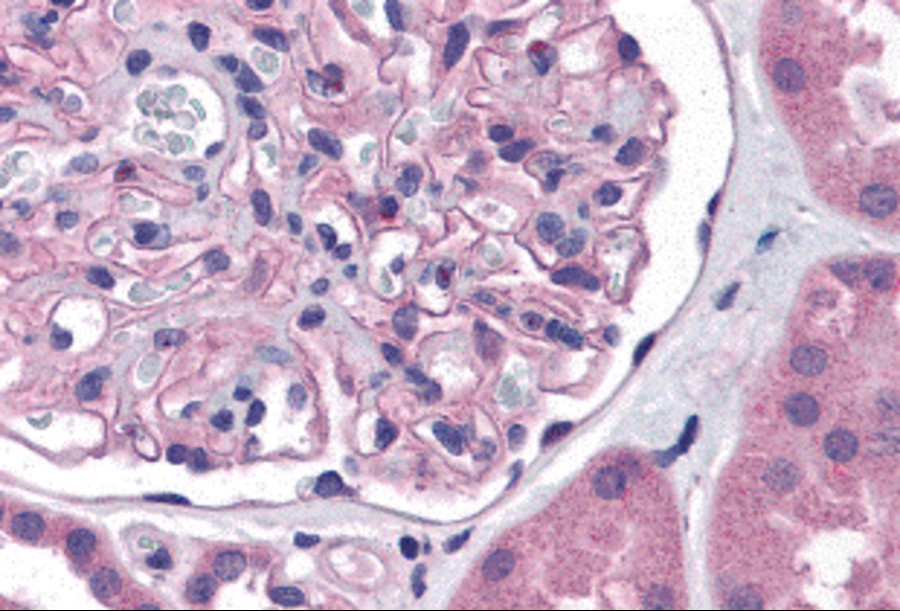
Immunohistochemistry of Nephrin in human kidney tissue with Nephrin antibody at 5 μg/mL.| Product Name | Nephrin Antibody |
|---|---|
| Antibody Type | Primary Antibodies |
| Antigen Alias | Nephrin Antibody: CNF, NPHN, nephrin, Nephrin, Renal glomerulus-specific cell adhesion receptor |
| Product description | Nephrin Antibody: Nephrin is strongly expressed in renal glomeruli and is a member of the immunoglobulin family of cell adhesion molecules. Mutations in the Nephrin gene result in congenital nephrotic syndrome, an autosomal-recessive disorder characterized by massive proteinuria in utero and nephrosis at birth. Renal glomeruli allow normal kidneys to filter plasma so that it is very pure. Nephrin is expressed in the podocyte slit-diaphragm of the renal glomeruli in a manner that suggests that Nephrin molecules homodimerize in an anti-parallel fashion similar to cadherin interactions in adherens junctions. Thus, Nephrin may constitute the entire extracellular structure of the slit-diaphragm.1) Kestila M, Lenkkeri U, Mannikko M, et al. Positionally cloned gene for a novel glomerular protein - Nephrin - is mutated in congenital nephrotic syndrome. Mol. Cell 1998; 1:575-582. |
| Immunogen | Nephrin antibody was raised against a 16 amino acid synthetic peptide from near the center of human Nephrin. The immunogen is located within amino acids 870 - 920 of Nephrin. |
| Clonality | Polyclonal |
|---|---|
| Isotype | IgG |
| Host Species | Rabbit |
| Tested Applications | ELISAIHC-P |
| Nephrin antibody can be used for detection of Nephrin by immunohistochemistry at 5 μg/mL.: |
|
| Species Reactivity | Human |
| Concentration | 1mg/ml |
| Purification | Affinity purified |
| Gene Symbol | NPHS1 |
|---|---|
| Alternative Names | Nephrin Antibody: CNF NPHN nephrin Nephrin Renal glomerulus-specific cell adhesion receptor |
| Sequence Similarities | Predicted species reactivity based on immunogen sequence: Mouse: (94%) |
Application
Immunohistochemistry of Nephrin in human kidney tissue with Nephrin antibody at 5 μg/mL.| Positive Control | 1) Cat. No. 10-401 - Human Kidney Tissue Slide |
|---|---|
| Application Notes | Nephrin antibody can be used for detection of Nephrin by immunohistochemistry at 5 μg/mL.: |
| Form | Liquid |
|---|---|
| Storage Instructions | Nephrin antibody can be stored at 4˚C for three months and -20˚C, stable for up to one year. As with all antibodies care should be taken to avoid repeated freeze thaw cycles. Antibodies should not be exposed to prolonged high temperatures. |
| Storage Buffer | Nephrin Antibody is supplied in PBS containing 0.02% sodium azide. |


