Application
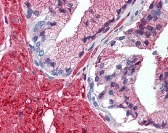
Immunohistochemistry staining of TRAF2 in prostate tissue using TRAF2 monoclonal Antibody.| Product Name | TRAF2 Antibody |
|---|---|
| Antibody Type | Primary Antibodies |
| Antigen Alias | TRAF2, MGC:45012, TRAP3 |
| Product description | Tumor necrosis factor (TNF) induced signaling is mediated through association of TNF receptor (TNFR) with adaptor proteins, such as TNF receptor associated proteins (TRAFs). TRAFs form a family of cytoplasmic adapter proteins that mediate signal transduction from many members of the TNF-receptor superfamily (e.g. RANK, CD30, CD40, etc.) and the interleukin-1 receptor. The carboxy-terminal region of TRAFs is required for self-association and interaction with receptor cytoplasmic domains following ligand-induced oligomerization. Recent molecular cloning studies have lead to identification of six TRAFs (TRAF1-TRAF6) (1-4). TRAF2 is a 502-amino acid protein. Mutagenic studies suggest that the N-terminal RING finger and two adjacent zinc fingers of TRAF2 are required for NF-κB activation, where as interaction with TNFR is mediated through C-terminus domain (5,6). Distinct domains in the N- and -C termini are also required for association with TRAF1 and protein kinase receptor interacting protein (RIP). TRAF2 is involved in cellular resistant to TNF-induced apoptosis. TRAF-2 deficient mice appeared normal at birth, however, they die prematurely, probably due to atrophy of thymus, spleen, muscle mass and lack of TRAF-2's cytoprotective role. |
| Immunogen | TRAF2 monoclonal antibody was raised against amino acids 205 - 222 of TRAF2 (Human). |
| Clonality | Monoclonal |
|---|---|
| Isotype | IgG |
| Host Species | Mouse |
| Tested Applications | IHCWB |
| TRAF2 antibody can be used in ELISA, Western Blot starting at 1:500 - 1:1000, immunohistochemistry starting at 5 μg/mL, and immunofluorescence starting at 10 μg/mL.: |
|
| Species Reactivity | Human |
| Concentration | 1mg/ml |
| Purification | Protein G |
| Gene Symbol | TRAF2 |
|---|---|
| Alternative Names | TRAF2 MGC:45012 TRAP3 |
| Tissue Specificity | In HeLa, an approx. 57 kD band is observed. |
Application
Immunohistochemistry staining of TRAF2 in prostate tissue using TRAF2 monoclonal Antibody.| Application Notes | TRAF2 antibody can be used in ELISA, Western Blot starting at 1:500 - 1:1000, immunohistochemistry starting at 5 μg/mL, and immunofluorescence starting at 10 μg/mL.: |
|---|
| Form | Liquid |
|---|---|
| Storage Instructions | TRAF2 antibody can be stored short term 4 ˚C. For long term storage aliquot and store at -20 ˚C. As with all antibodies avoid freeze/thaw cycles. |
| Storage Buffer | PBS, 0.2% gelatin, 0.05% sodium azide. |


