Application
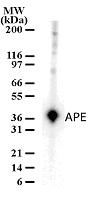
Western blot analysis of APE in HeLa lysates using APE antibody at 2 ug/ml.Application
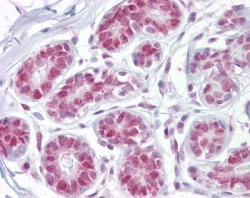
Human breast: Formalin-Fixed, Paraffin-Embedded (FFPE) using APE antibody at 10 ug/ml.| Product Name | APE1 antibody |
|---|---|
| Antibody Type | Primary Antibodies |
| Product description | Rabbit polyclonal antibody to APE1Mammalian apurinic/apyrimidinic endonuclease (APE/ref-1) is a multifunctional, bipartite enzyme that plays an important role in numerous, cellular functions. APE is responsible for repairing abasic sites in DNA and in regulating the redox state of other proteins that play roles in oxidative signaling, transcription factor regulation (Fos, Jun, NFkB, Myb, HIF1 alpha, CREB, Pax), cell cycle control (p53), and apoptosis. Altered levels of APE have also been found in some cancers. The most common form of DNA damage is the creation of abasic sites which are brought about through spontaneous loss or oxidative DNA damage, through chemically initiated hydrolysis (chemotherapy), ionizing radiation, UV irradiation, oxidizing agents, and removal of modified bases by DNA glycosylases. |
| Immunogen | KLH conjugated synthetic peptides corresponding to amino acids 36-52 and 216-232 of human APE. |
| Clonality | Polyclonal |
|---|---|
| Isotype | IgG |
| Host Species | Rabbit |
| Tested Applications | IHC-PWB |
| WB: Use at a concentration of 1 - 2 μg/ml. Detects a band of approximately 37 kDa (predicted molecular weight: 35 kDa). Optimal dilutions/concentrations should be determined by the end user. | |
| Species Reactivity | Human |
| Concentration | 0.5mg/ml |
| Purification | Protein G |
| Gene Synonyms | 328, APEX, REF1, 107748, P27695, APE1, APEX1, HAP1, APE, APX, REF-1, APEN, REF 1 |
|---|---|
| Target | APE1 |
| Cellular Localization | Nuclear |
Application
Western blot analysis of APE in HeLa lysates using APE antibody at 2 ug/ml.
Application
Human breast: Formalin-Fixed, Paraffin-Embedded (FFPE) using APE antibody at 10 ug/ml.| Positive Control | HeLa cell lysates. |
|---|---|
| Application Notes | WB: Use at a concentration of 1 - 2 μg/ml. Detects a band of approximately 37 kDa (predicted molecular weight: 35 kDa). Optimal dilutions/concentrations should be determined by the end user. |
| Form | Liquid |
|---|---|
| Storage Instructions | Keep as concentrated solution. Store at 4ºC short term. For extended storage aliquot and store at -20ºC or below. Avoid freeze-thaw cycles. |
| Storage Buffer | Preservative: 0.02% Sodium Azide; Constituents: PBS |


