Application
ApplicationApplication
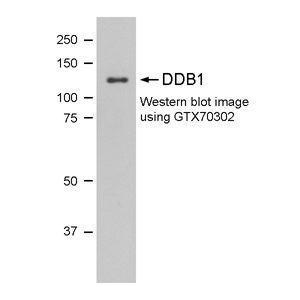
Western blot using - Detection of Human DDB1 protein by western blot experiment in T47D whole cell lysate by .| Product Name | DDB1 antibody |
|---|---|
| Antibody Type | Primary Antibodies |
| Product description | Mouse monoclonal to human DDB1The DNA damage-binding protein from HeLa cells is associated with polypeptides of relative mass 124,000 (DDB1) and 41,000 (DDB2) as determined by SDS-polyacrylamide gels. To test whether the DNA-repair defect in the subset of XPE patients that lack DNA damage-binding activity is caused by a defect in DDB, Keeney et al. (1994) injected purified human DDB protein into XPE cells. The injected DDB protein stimulated DNA repair to normal levels in those strains that lacked the DDB activity but did not stimulate repair in cells from XPE patients that contained the activity. These results provided direct evidence that defective DDB activity causes the repair defect in a subset of XPE patients and establishes a role for this activity in nucleotide-excision repair in vivo. It remains for mutation analysis to demonstrate whether the defect in XPE patients is in the DDB1 gene or the DDB2 gene. |
| Immunogen | Synthetic peptide congugated to protein carrier. The mice were immunized with a combination of N & C peptide. The Swiss Prot ID is Q16531. |
| Clonality | Monoclonal |
|---|---|
| Isotype | IgG |
| Clone Number | 1322 |
| Host Species | Mouse |
| Tested Applications | ELISAWB |
| For ELISA: Use at an assay dependent dilution. For WB(ECL): Use at a dilution of 1:1,000 in 5% Milk/PBS containing 0.05% Tween. We recommend an overnight incubation at 4¡C. Secondary antibody (GTX30590) 2 hours at RT with dilution of 1:5,000 in 5% Milk/PBS containing 0.05% Tween. Not tested in other applictions. Optiamal dilutions/concentrations should be determined by the researcher.: |
|
| Species Reactivity | Human |
| Concentration | 1mg/ml |
| Purification | Affinity purified |
| Gene Synonyms | DDBA UV-DDB1 XAP1 XPCE XPE XPE-BF XPE BF UV DDB1 XPEBF UVDDB1 |
|---|---|
| Target | DDB1 |
| Molecular Weight(MW) | 130 kDa (note) |
| Cellular Localization | Nuclear |
Application
Application
Application
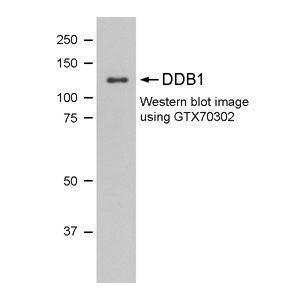
Western blot using - Detection of Human DDB1 protein by western blot experiment in T47D whole cell lysate by .| Positive Control | T47D and MCF-7 whole cell lysate |
|---|---|
| Application Notes | For ELISA: Use at an assay dependent dilution. For WB(ECL): Use at a dilution of 1:1,000 in 5% Milk/PBS containing 0.05% Tween. We recommend an overnight incubation at 4¡C. Secondary antibody (GTX30590) 2 hours at RT with dilution of 1:5,000 in 5% Milk/PBS containing 0.05% Tween. Not tested in other applictions. Optiamal dilutions/concentrations should be determined by the researcher.: |
| Form | Liquid |
|---|---|
| Storage Instructions | For long term storage, please keep at -70 °C or below. Avoid repeated freeze-thaw cycles. |
| Storage Buffer | Phosphate-buffered saline, pH 7.2, containing no preservatives |


