Application
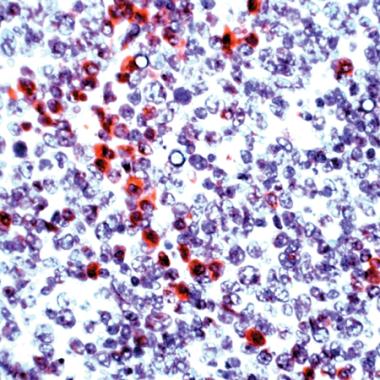
Human Tonsil stained with anti-Granzyme B antibody| Product Name | Granzyme B antibody (ready-to-use) |
|---|---|
| Antibody Type | Primary Antibodies |
| Product description | Rabbit polyclonal to Granzyme B predilutedThe Lytic enzymes of cytotoxic lymphocytes seem to be contained within lysosome-like granules found in the cytoplasm. These granules contain perforin, a membrane pore-forming protein, and a family of serine proteases (granzymes). Granzyme B, a 32 kDa protein, is a serine Aspase associated with the granules of Natural Killer (NK) cells. Granzyme B seems to be able to elicit cell death, perhaps by activating an endogenous pathway of programmed cell death. |
| Immunogen | Synthetic peptide (unfortunately, the amino acid sequence is considered to be commercially sensitive) (Human) (N terminal). |
| Clonality | Polyclonal |
|---|---|
| Isotype | IgG |
| Host Species | Rabbit |
| Tested Applications | IHC-P |
| IHC-P: Use at an assay dependent dilution. Staining of formalin-fixed tissues requires boiling tissue sections in 10mM citrate buffer, pH 6.0 for 10 min followed by cooling at RT for 20 min. Optimal dilutions/concentrations should be determined by the end user.: |
|
| Species Reactivity | HumanMouseRat |
| Concentration | 1mg/ml |
| Purification | Affinity purified |
| Gene Synonyms | Granzyme B CCPI CGL1 3002 GZMB CTSGL1 CGL-1 CSP-B P10144 123910 CTLA1 CSPB SECT HLP CGL 1 CSP B |
|---|---|
| Target | Granzyme B |
| Cellular Localization | Cytoplasmic granules of cytolytic T-Lymphocytes |
Application
Human Tonsil stained with anti-Granzyme B antibody| Positive Control | Tonsil |
|---|---|
| Application Notes | IHC-P: Use at an assay dependent dilution. Staining of formalin-fixed tissues requires boiling tissue sections in 10mM citrate buffer, pH 6.0 for 10 min followed by cooling at RT for 20 min. Optimal dilutions/concentrations should be determined by the end user.: |
| Form | Liquid |
|---|---|
| Storage Instructions | Keep as concentrated solution, aliquot and store at 4°C. Do not freeze. |
| Storage Buffer | Phosphate-buffered saline, pH 7.4 containing 1%BSA and 0.1% sodium azide |


