Application
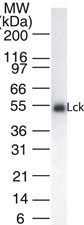
Western blot analysis for Lck at 1:1000 dilution against 20 ug/lane of Jurkat cell lysate.| Product Name | Lck antibody |
|---|---|
| Antibody Type | Primary Antibodies |
| Product description | Mouse monoclonal [33D196] to LckLck is a lymphoid-specific cytosolic protein tyrosine kinase (PTK), which is essential for T-cell development and function. It is constitutively associated with the cytoplasmic portions of the CD4 and CD8 surface receptors and plays a key role in T-cell antigen receptor (TCR)-linked signal transduction pathways. Association of the TCR with a peptide antigen-bound MHC complex facilitates the interaction of CD4 and CD8 with MHC class II and class I molecules, respectively, and thereby recruits the associated Lck to the vicinity of the TCR/CD3 complex. Lck then phosphorylates tyrosine residues within the immunoreceptor tyrosine-based activation motifs (ITAMs) in the cytoplasmic tails of the TCR-chains and CD3 subunits. The phospho-ITAMs serve as docking sites for Src homology domain 2 (SH2)-containing molecules, predominantly ZAP-70 and Syk. Only then can ZAP-70 undergo tyrosine phosphorylation, become enzymatically active and further phosphorylate downstream effector molecules. In addition, Lck contributes to signaling by other receptor molecules. Lck is expressed at all stages of thymocyte development and is required for the regulation of maturation events that are governed by both pre-TCR and mature TCR. |
| Immunogen | Synthetic peptide (Human). |
| Clonality | Monoclonal |
|---|---|
| Isotype | IgG2 |
| Clone Number | 33D196 |
| Host Species | Mouse |
| Tested Applications | WB |
| WB: Use at a dilution of 1/500 - 1/1000. Detects a band of approximately 54 kDa. Optimal dilutions/concentrations should be determined by the end user.: |
|
| Species Reactivity | HumanMouse |
| Concentration | 0.5mg/ml |
| Purification | Protein G |
| Gene Synonyms | LSK YT16 p56lck pp58lck |
|---|---|
| Target | Lck |
| Cellular Localization | Cytoplasmic |
| Light Chain Type | kappa |
Application
Western blot analysis for Lck at 1:1000 dilution against 20 ug/lane of Jurkat cell lysate.| Positive Control | Jurkat cell lysate. |
|---|---|
| Application Notes | WB: Use at a dilution of 1/500 - 1/1000. Detects a band of approximately 54 kDa. Optimal dilutions/concentrations should be determined by the end user.: |
| Form | Liquid |
|---|---|
| Storage Instructions | Keep as concentrated solution. Store at 4ºC short term. For extended storage aliquot and store at -20ºC or below. Avoid freeze-thaw cycles. |
| Storage Buffer | Preservative: 0.02% Sodium Azide; Constituents: PBS. |


