Application
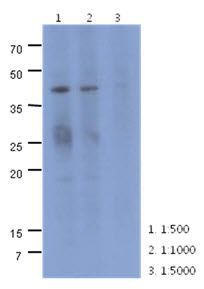
WB analysis of HepG2 lysate (40ug) using MVK antibody at the indicated dilutions.| Product Name | MVK antibody |
|---|---|
| Antibody Type | Primary Antibodies |
| Product description | Mouse monoclonal antibody [AT14F6] to MVKThis gene encodes the peroxisomal enzyme mevalonate kinase. Mevalonate is a key intermediate, and mevalonate kinase a key early enzyme, in isoprenoid and sterol synthesis. Mevalonate kinase deficiency caused by mutation of this gene results in mevalonic aciduria, a disease characterized psychomotor retardation, failure to thrive, hepatosplenomegaly, anemia and recurrent febrile crises. Defects in this gene also cause hyperimmunoglobulinaemia D and periodic fever syndrome, a disorder characterized by recurrent episodes of fever associated with lymphadenopathy, arthralgia, gastrointestinal dismay and skin rash. Two transcript variants that encode the same protein have been found for this gene. [provided by RefSeq, Jul 2008] |
| Immunogen | Recombinant human MVK (1-396aa) purified from E. coli |
| Clonality | Monoclonal |
|---|---|
| Isotype | IgG3 |
| Clone Number | AT14F6 |
| Host Species | Mouse |
| Tested Applications | ELISAWB |
| The antibody has been tested by ELISA, Western blot analysis to assure specificity and reactivity. Since application varies, however, each investigation should be titrated by the reagent to obtain optimal results. Recommended dilution range for Western blot analysis is 1:500 ~ 1:5000. Recommended starting dilution is 1:1000.: |
|
| Species Reactivity | Human |
| Concentration | 1mg/ml (Please refer to the vial label for the specific concentration) |
| Purification | Affinity purified |
| Gene Synonyms | mevalonate kinase POROK3 MVLK LRBP MK |
|---|---|
| Target | MVK |
| Light Chain Type | kappa |
Application
WB analysis of HepG2 lysate (40ug) using MVK antibody at the indicated dilutions.| Application Notes | The antibody has been tested by ELISA, Western blot analysis to assure specificity and reactivity. Since application varies, however, each investigation should be titrated by the reagent to obtain optimal results. Recommended dilution range for Western blot analysis is 1:500 ~ 1:5000. Recommended starting dilution is 1:1000.: |
|---|
| Form | Liquid |
|---|---|
| Storage Instructions | Can be stored at +4C. For long term storage, aliquot and store at -20C. Avoid repeated freezing and thawing cycles. |
| Storage Buffer | Phosphate-Buffered Saline (pH 7.4) containing 10% Glycerol, 0.02% Sodium Azide. |


