Application
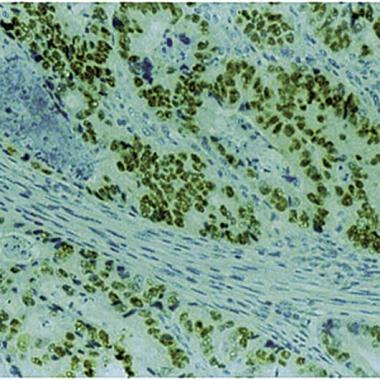
Formalin fixed paraffin embedded human colon carcinoma stained with p53 antibody .| Product Name | p53 antibody (ready-to-use) |
|---|---|
| Antibody Type | Primary Antibodies |
| Product description | Mouse monoclonal [DO-7] to p53 predilutedThe 393 amino acid tumor suppressor phosphoprotein p53 plays a major role in the cellular response to DNA damage and other genomic aberrations. The activation of p53 can lead to either cell cycle arrest and DNA repair, or apoptosis. p53 is phosphorylated at multiple sites in vivo and by several different protein kinases in vitro. p53 can apparently be phosphorylated by ATM, ATR, and DNA-PK at Ser15; the phosphorylation impairs the ability of MDM2 to bind p53, promoting both the accumulation and functional activation of p53 in response to DNA damage. |
| Immunogen | Recombinant human wild type p53 protein expressed in E. coli. |
| Clonality | Monoclonal |
|---|---|
| Isotype | IgG2 |
| Clone Number | DO-7 |
| Host Species | Mouse |
| Tested Applications | IHC-FIHC-P |
| This antibody has been pretitered and quality controlled to work allon formalin-fixed paraffin-embedded as well as acetone fixed cryostat tissue sections. No further titration is required. We suggest an incubation period of 30-60 minutes at room temperature. However, depending upon the fixation conditions and the staining system employed, optimal incubation should be determined by the user. Proteolytic digestion of tissue sections is required prior to immunostaining. Although not required, microwave treatment, cosiderably enhances the immunostaining in formalin-fixed tissues.: |
|
| Species Reactivity | Human |
| Concentration | 1mg/ml |
| Gene Synonyms | Antigen NY CO 13 Cellular tumor antigen p53 Phosphoprotein p53 TP 53 TP53 Transformation Related Protein p53 TRP 53 TRP53 Tumor protein p53 Li Fraumeni syndrome Tumor suppressor p53 Tumour Protein p53 |
|---|---|
| Target | TP53 |
| Tissue Specificity | This antibody reacts with wild type as well as mutant types of p53 protein. It recognizes an epitope in the N-terminus of p53 protein, known to reside between amino acids 35 to 45. This antibody will stain between 22-76% of colon, stomach,allbladder, breast, lung and testes cancers. |
| Cellular Localization | Cytoplasmic and Nuclear |
| Light Chain Type | kappa |
Application
Formalin fixed paraffin embedded human colon carcinoma stained with p53 antibody .| Application Notes | This antibody has been pretitered and quality controlled to work allon formalin-fixed paraffin-embedded as well as acetone fixed cryostat tissue sections. No further titration is required. We suggest an incubation period of 30-60 minutes at room temperature. However, depending upon the fixation conditions and the staining system employed, optimal incubation should be determined by the user. Proteolytic digestion of tissue sections is required prior to immunostaining. Although not required, microwave treatment, cosiderably enhances the immunostaining in formalin-fixed tissues.: |
|---|
| Form | Liquid |
|---|---|
| Storage Instructions | Keep as concentrated solution, aliquot and store at 4°C. Do not freeze. |
| Storage Buffer | PBS with sodium azide |


