Application
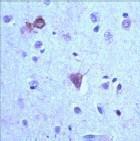
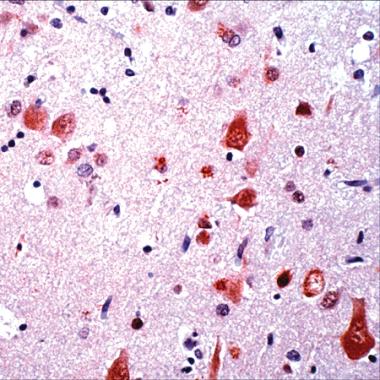
staining Parkin in Alzheimers brain by Immunohistochemistry (FFPE-sections).Application
Human Alzheimer's Brain stained with anti-Parkin antibody| Product Name | Parkin antibody (ready-to-use) |
|---|---|
| Antibody Type | Primary Antibodies |
| Product description | Rabbit polyclonal to Parkin predilutedParkinson's Disease, the second most common neurodegenerative disease after Alzheimer's Disease, is characterized by the loss of dopaminergic neurons and the presence of Lewy bodies (comprised of alpha-synuclein and parkin inclusions). Autosomal Recessive Juvenile Parkinsonism (AR-JP) is a recently described form of Parkinson's Disease that has been linked to a gene that codes for parkin. Parkin, a 52 kDa protein, has a suggested role in the ubiquitin/proteasome pathway for protein degradation. The amino terminus bears sequence homology to ubiquitin while functionally it acts as a RING-type ubiquitin protein ligase (E3) that coordinates the transfer of ubiquitin to substrate proteins, thus targeting them for degradation by the proteasome. |
| Immunogen | Synthetic peptide (unfortunately, the amino acid sequence is considered to be commercially sensitive) (Human) (N terminal). |
| Clonality | Polyclonal |
|---|---|
| Isotype | IgG |
| Host Species | Rabbit |
| Tested Applications | IHC-P |
| IHC-P: Working dilution, ready to use for 10 minutes at RT. Staining of formalin-fixed tissues requires boiling tissue sections in 10mM citrate buffer, pH 6.0 for 10 minutes followed by cooling at RT for 20 minutes. GTX15495 demonstrates cytoplasmic staining. Optimal dilutions/concentrations should be determined by the end user.: |
|
| Species Reactivity | HumanMouseRat |
| Concentration | 1mg/ml |
| Purification | Affinity purified |
| Gene Synonyms | AR-JP LPRS2 PDJ PRKN AR JP ARJP |
|---|---|
| Target | Parkin |
Application
staining Parkin in Alzheimers brain by Immunohistochemistry (FFPE-sections).
Application
Human Alzheimer's Brain stained with anti-Parkin antibody| Positive Control | Brain |
|---|---|
| Application Notes | IHC-P: Working dilution, ready to use for 10 minutes at RT. Staining of formalin-fixed tissues requires boiling tissue sections in 10mM citrate buffer, pH 6.0 for 10 minutes followed by cooling at RT for 20 minutes. GTX15495 demonstrates cytoplasmic staining. Optimal dilutions/concentrations should be determined by the end user.: |
| Form | Liquid |
|---|---|
| Storage Instructions | Keep as concentrated solution and store at 4°C. Do not freeze. |
| Storage Buffer | PBS, pH 7.4 containing 1%BSA and 0.1% sodium azide |


