Application
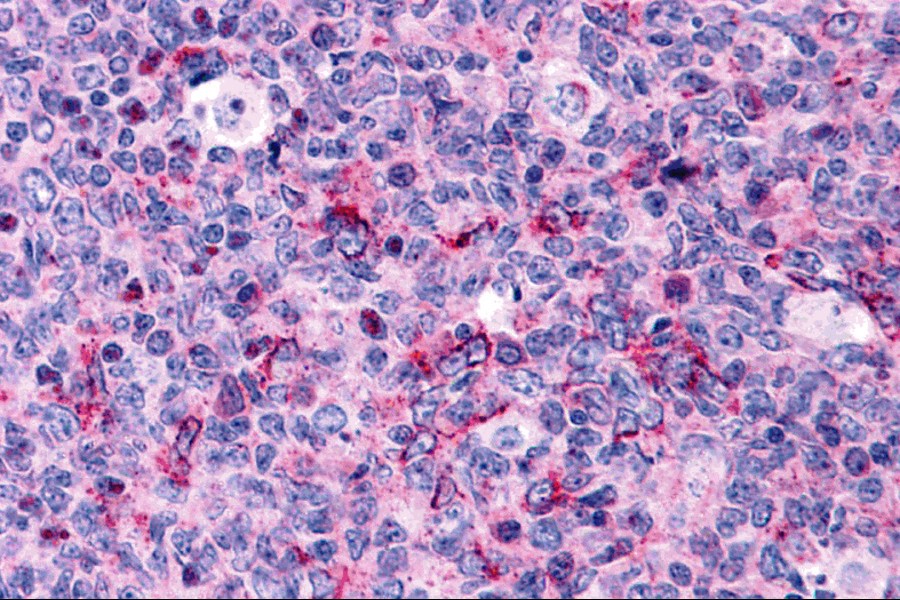
Immunohistochemistry of Caspase-3 in human tonsil tissue with Caspase-3 antibody at 5 μg/mL.| Product Name | Caspase-3 Antibody |
|---|---|
| Antibody Type | Primary Antibodies |
| Product description | Caspase-3 Antibody: Caspases are a family of cysteine proteases that can be divided into the apoptotic and inflammatory caspase subfamilies. Unlike the apoptotic caspases, members of the inflammatory subfamily are generally not involved in cell death but are associated with the immune response to microbial pathogens. The apoptotic subfamily can be further divided into initiator caspases, which are activated in response to death signals, and executioner caspases, which are activated by the initiator caspases and are responsible for cleavage of cellular substrates that ultimately lead to cell death. Caspase-3 is synthesized as an inactive proenzyme that undergoes proteolytic cleavage by caspases 8, 9 and 10 to produce 2 subunits, termed p20 and p11. These subunits dimerize to form the active enzyme. Caspase-3 proteolytically cleaves and activates other proteins such as caspases 6, 7 and 9.1) Martinon F and Tschopp J. Inflammatory caspases: linking an intracellular innate immune system to autoinflammatory diseases. Cell 2004; 117:561-74 |
| Immunogen | Caspase-3 antibody was raised against a 17 amino acid synthetic peptide near the center of human Caspase-3. The immunogen is located within amino acids 70 - 120 of Caspase-3. |
| Clonality | Polyclonal |
|---|---|
| Isotype | IgG |
| Host Species | Rabbit |
| Tested Applications | ELISAIHC-P |
| Caspase-3 antibody can be used for detection of Caspase-3 by immunohistochemistry at 5 μg/mL.: |
|
| Species Reactivity | Human |
| Concentration | 1mg/ml |
| Purification | Affinity purified |
| Gene Symbol | CASP3 |
|---|---|
| Alternative Names | Caspase-3 Antibody: CPP32 SCA-1 CPP32B CPP32 Caspase-3 Apopain CASP-3 |
| Molecular Weight(MW) | 30 kDa |
Application
Immunohistochemistry of Caspase-3 in human tonsil tissue with Caspase-3 antibody at 5 μg/mL.| Application Notes | Caspase-3 antibody can be used for detection of Caspase-3 by immunohistochemistry at 5 μg/mL.: |
|---|
| Form | Liquid |
|---|---|
| Storage Instructions | Caspase-3 antibody can be stored at 4˚C for three months and -20˚C, stable for up to one year. As with all antibodies care should be taken to avoid repeated freeze thaw cycles. Antibodies should not be exposed to prolonged high temperatures. |
| Storage Buffer | Caspase-3 Antibody is supplied in PBS containing 0.02% sodium azide. |


