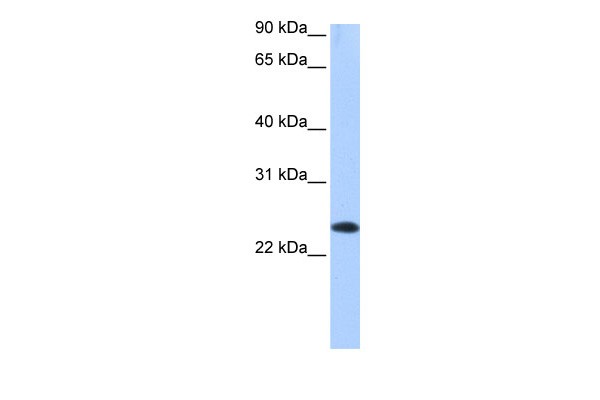
Application
Antibody used in WB on Human Brain at 0.2-1 ug/ml.| Product Name | EGLN3 Antibody |
|---|---|
| Antibody Type | Primary Antibodies |
| Antigen Alias | EGLN3, FLJ21620, HIFPH3, MGC125998, MGC125999, PHD3, HIFP4H3 |
| Product description | EGLN3 catalyzes the post-translational formation of 4-hydroxyproline in hypoxia-inducible factor (HIF) alpha proteins. It hydroxylates HIF-1 alpha at 'Pro-564', and HIF-2 alpha. EGLN3 functions as a cellular oxygen sensor and, under normoxic conditions, targets HIF through the hydroxylation for proteasomal degradation via the von Hippel-Lindau ubiquitination complex. It may play a role in cell growth regulation in muscle cells and in apoptosis in neuronal tissue. EGLN3 promotes cell death through a caspase-dependent mechanism.1) Ginouves, A., (2008) Proc. Natl. Acad. Sci. U.S.A. 105 (12), 4745-4750. |
| Immunogen | Antibody produced in rabbits immunized with a synthetic peptide corresponding a region of human EGLN3. |
| Clonality | Polyclonal |
|---|---|
| Host Species | Rabbit |
| Tested Applications | ELISAWB |
| EGLN3 antibody can be used for detection of EGLN3 by ELISA at 1:1562500. EGLN3 antibody can be used for detection of EGLN3 by western blot at 1 μg/mL, and HRP conjugated secondary antibody should be diluted 1:50,000 - 100,000.: |
|
| Species Reactivity | HumanMouseRat |
| Concentration | 1mg/ml |
| Purification | Affinity purified |
| Gene Symbol | EGLN3 |
|---|---|
| Alternative Names | EGLN3 FLJ21620 HIFPH3 MGC125998 MGC125999 PHD3 HIFP4H3 |
| Molecular Weight(MW) | 27 kDa |
Application
Antibody used in WB on Human Brain at 0.2-1 ug/ml.| Positive Control | 1) Cat. No. XBL-10123 - Fetal Brain Tissue Lysate |
|---|---|
| Application Notes | EGLN3 antibody can be used for detection of EGLN3 by ELISA at 1:1562500. EGLN3 antibody can be used for detection of EGLN3 by western blot at 1 μg/mL, and HRP conjugated secondary antibody should be diluted 1:50,000 - 100,000.: |
| Form | Liquid |
|---|---|
| Storage Instructions | For short periods of storage (days) store at 4˚C. For longer periods of storage, store EGLN3 antibody at -20˚C. As with any antibody avoid repeat freeze-thaw cycles. |
| Storage Buffer | Antibody is lyophilized in PBS buffer with 2% sucrose. Add 50 μL of distilled water. Final antibody concentration is 1 mg/mL. |


