Application
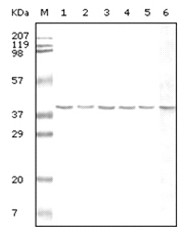
Western blot analysis of GAPDH using Hela, K562, Jurkat, NIH / 3T3, HepG2 cell lysate, and human stomach carcinoma tissue lysate .| Product Name | GAPDH Antibody |
|---|---|
| Antibody Type | Primary Antibodies |
| Antigen Alias | GAPD, CDABP0047, OK/SW-cl.12, Peptidyl-cysteine S-nitrosylase GAPDH, GAPDH, G3PD, GAPD, HEL-S-162eP |
| Product description | Glyceraldehyde-3-phosphate dehydrogenase (GAPDH) is well known as one of the key enzymes involved in glycolysis. It catalyzes an important energy-yielding step in carbohydrate metabolism, the reversible oxidative phosphorylation of glyceraldehyde-3-phosphate in the presence of inorganic phosphate and nicotinamide adenine dinucleotide (NAD). The enzyme exists as a tetramer of identical chains. Besides its functioning as a glycolytic enzyme in cytoplasm, recent evidence suggest that mammalian GAPDH is also involved in a great number of intracellular proceses such as membrane fusion, microtubule bundling, phosphotransferase activity, nuclear RNA export, DNA replication, and DNA repair. During the last decade a lot of findings appeared concerning the role of GAPDH in different pathologies including prostate cancer progression, programmed neuronal cell death, age- related neuronal diseases, such as Alzheimer’s and Huntington’s disease.1) Allen R.W. J. Biol. Chem. 1987.262:649-653. |
| Immunogen | Ni-NTA purified recombinant human GAPDH expressed in E. Coli strain BL21 (DE3). |
| Clonality | Monoclonal |
|---|---|
| Isotype | IgG1 |
| Host Species | Mouse |
| Tested Applications | ELISAIFIHCWB |
| Western Blot:1:500 - 1:2,000 IHC(P/F):1:200 - 1:1,000 IF:1:200 - 1:1,000 ELISA:Propose dilution 1:10,000. Determining optimal working dilutions by titration test.: |
|
| Species Reactivity | Human |
| Concentration | 1mg/ml |
| Gene Symbol | GAPDH |
|---|---|
| Alternative Names | GAPD CDABP0047 OK/SW-cl.12 Peptidyl-cysteine S-nitrosylase GAPDH GAPDH G3PD GAPD HEL-S-162eP |
| Sequence Similarities | 2) Cat. No. 1205 - Jurkat Cell Lysate |
Application
Western blot analysis of GAPDH using Hela, K562, Jurkat, NIH / 3T3, HepG2 cell lysate, and human stomach carcinoma tissue lysate .| Positive Control | 1) Cat. No. 1201 - HeLa Cell Lysate |
|---|---|
| Application Notes | Western Blot:1:500 - 1:2,000 IHC(P/F):1:200 - 1:1,000 IF:1:200 - 1:1,000 ELISA:Propose dilution 1:10,000. Determining optimal working dilutions by titration test.: |
| Form | Liquid |
|---|---|
| Storage Instructions | GAPDH monoclonal antibody can be stored at -20˚C, stable for one year. As with all antibodies care should be taken to avoid repeated freeze thaw cycles. Antibodies should not be exposed to prolonged high temperatures. |
| Storage Buffer | Ascitic fluid containing 0.03% sodium azide. |


