Application
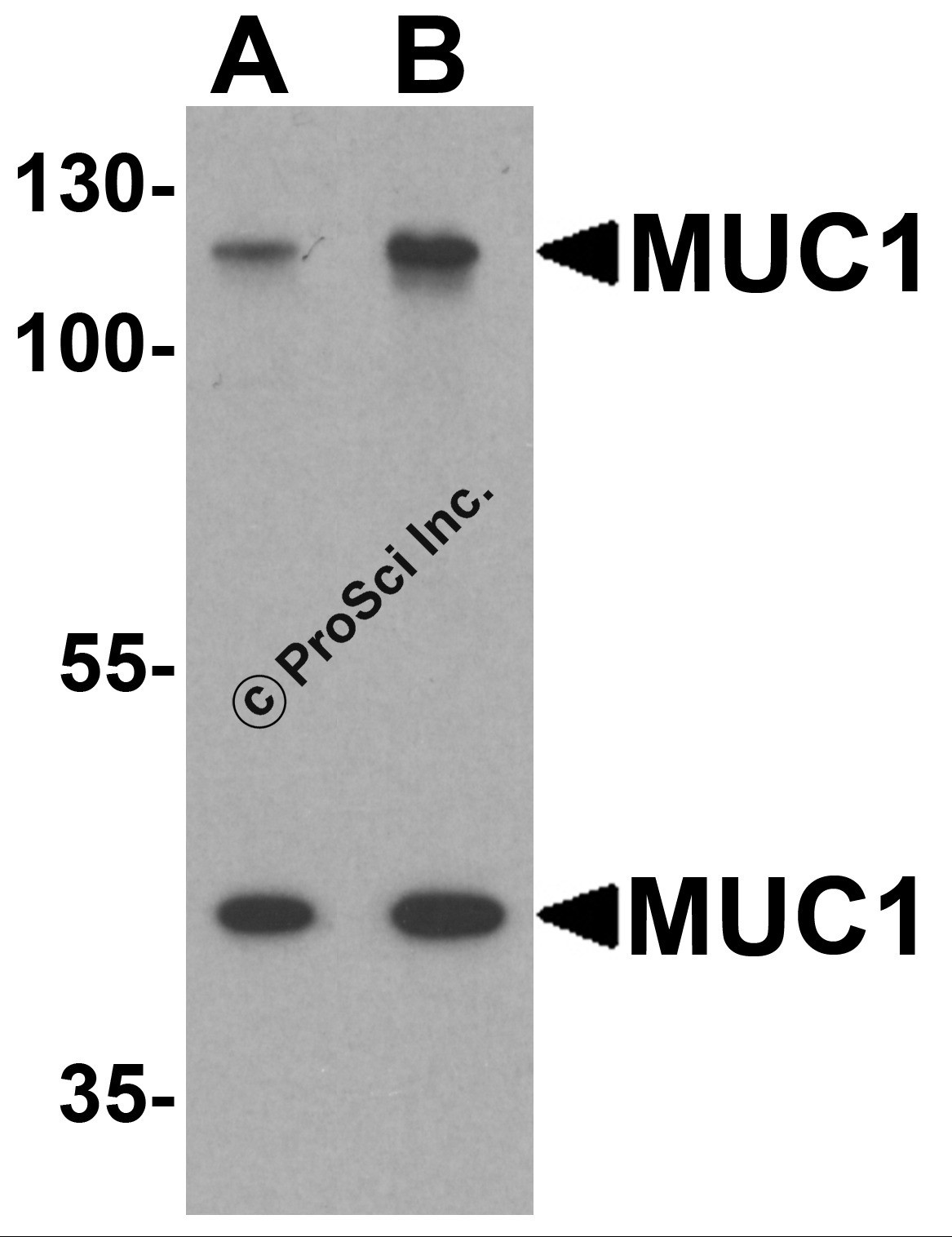
Western blot analysis of MUC1 in HeLa cell lysate with MUC1 antibody at (A) 1 and (B) 2 μg/ml.| Product Name | MUC1 Antibody |
|---|---|
| Antibody Type | Primary Antibodies |
| Product description | Mucin 1 (MUC1) is membrane-bound protein member of the mucin family. Mucins are O-glycosylated proteins that play an essential role in forming protective mucous barriers on epithelial surfaces and also play a role in intracellular signaling (1). MUC1 is expressed on the apical surface of epithelial cells that line the mucosal surfaces of many different tissues including lung, breast stomach and pancreas. MUC1 is proteolytically cleaved into alpha and beta subunits that form a heterodimeric complex. The N-terminal alpha subunit functions in cell-adhesion and the C-terminal beta subunit is involved in cell signaling. Overexpression, aberrant intracellular localization, and changes in glycosylation of this protein have been associated with carcinomas (1).1) Singh R and Bandyopadhyay D. MUC1: a target molecule for cancer therapy. Cancer Biol. Ther. 2007; 6:481-6. |
| Immunogen | MUC1 antibody was raised against a 17 amino acid peptide near the carboxy terminus of human MUC1. The immunogen is located within the last 50 amino acids of MUC1 . |
| Clonality | Polyclonal |
|---|---|
| Isotype | IgG |
| Host Species | Rabbit |
| Tested Applications | WB |
| MUC1 antibody can be used for detection of MUC1 by Western blot at 1 - 2 μg/ml. | |
| Species Reactivity | Human |
| Concentration | 1mg/ml |
| Purification | Affinity purified |
| Gene Symbol | MUC1 |
|---|---|
| Alternative Names | MUC1 Antibody : EMA MCD PEM PUM KL-6 MAM6 MCKD PEMT CD227 H23AG MCKD1 MUC-1 ADMCKD ADMCKD1 CA 15-3 MUC-1/X MUC1/ZD MUC-1/SEC Mucin-1 Breast carcinoma-associated antigen DF3 |
| Molecular Weight(MW) | Predicted: 53 (+ multiple others) kDa Observed:42, 120 kDa |
| Sequence Similarities | Predicted species reactivity based on immunogen sequence: Bovine: (83%) |
| Tissue Specificity | MUC1 antibody is human and mouse reactive. Multiple isoforms of MUC1 are known to exist. MUC1 often migrates at a higher molecular weight in SDS-PAGE due to high levels of post-translational modification. |
| Entrez Gene | 4582 |
|---|---|
| Protein Accession | NP_001191215 |
Application
Western blot analysis of MUC1 in HeLa cell lysate with MUC1 antibody at (A) 1 and (B) 2 μg/ml.| Positive Control | 1) Cat. No. 1201 - HeLa Cell Lysate |
|---|---|
| Application Notes | MUC1 antibody can be used for detection of MUC1 by Western blot at 1 - 2 μg/ml. |
| Form | Liquid |
|---|---|
| Storage Instructions | MUC1 antibody can be stored at 4˚C for three months and -20˚C, stable for up to one year. |
| Storage Buffer | MUC1 Antibody is supplied in PBS containing 0.02% sodium azide. |


