Application
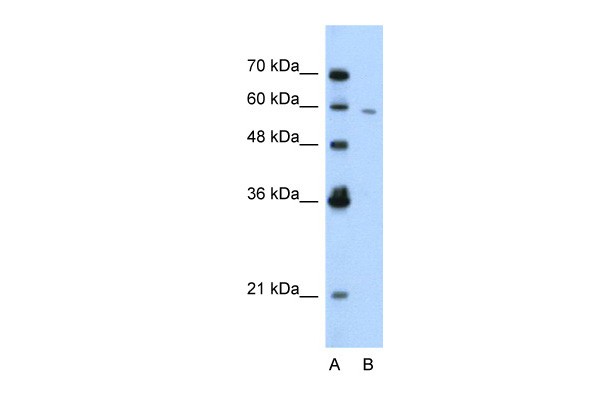
Antibody used in WB on Human Jurkat 1.25 ug/ml.Application
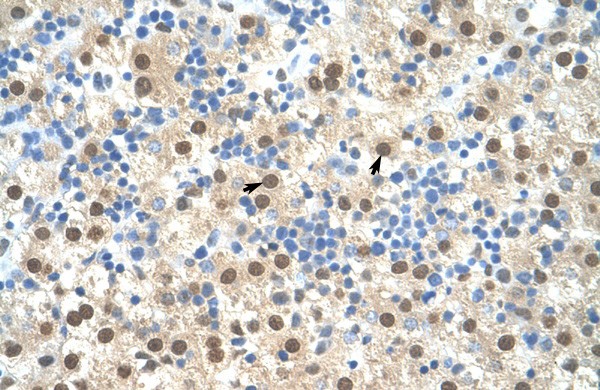
Antibody used in IHC on Human Liver cell lysates.Application
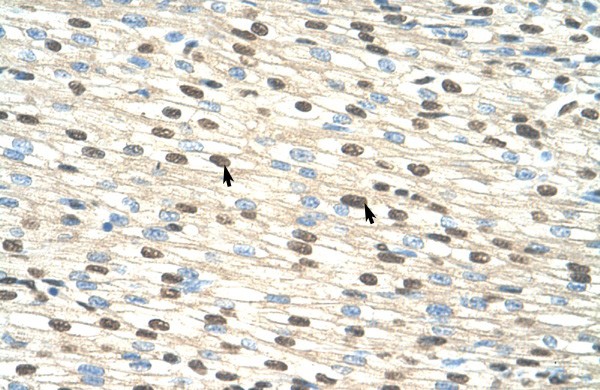
Antibody used in IHC on Human Heart lysate.| Product Name | RIPK3 Antibody |
|---|---|
| Antibody Type | Primary Antibodies |
| Antigen Alias | RIPK3, RIP3, RIP3 beta, RIP3 gamma |
| Product description | RIPK3 is a member of the receptor-interacting protein (RIP) family of serine/threonine protein kinases, and contains a C-terminal domain unique from other RIP family members. The protein is predominantly localized to the cytoplasm, and can undergo nucleocytoplasmic shuttling dependent on novel nuclear localization and export signals. It is a component of the tumor necrosis factor (TNF) receptor-I signaling complex, and can induce apoptosis and weakly activate the NF-kappaB transcription factor.The product of this gene is a member of the receptor-interacting protein (RIP) family of serine/threonine protein kinases, and contains a C-terminal domain unique from other RIP family members. The encoded protein is predominantly localized to the cytoplasm, and can undergo nucleocytoplasmic shuttling dependent on novel nuclear localization and export signals. It is a component of the tumor necrosis factor (TNF) receptor-I signaling complex, and can induce apoptosis and weakly activate the NF-kappaB transcription factor.1) Kimura, K., (2006) Genome Res. 16 (1), 55-65. |
| Immunogen | Antibody produced in rabbits immunized with a synthetic peptide corresponding a region of human RIPK3. |
| Clonality | Polyclonal |
|---|---|
| Host Species | Rabbit |
| Tested Applications | ELISAIHCWB |
| RIPK3 antibody can be used for detection of RIPK3 by ELISA at 1:62500. RIPK3 antibody can be used for detection of RIPK3 by western blot at 1.25 μg/mL, and HRP conjugated secondary antibody should be diluted 1:50,000 - 100,000.: |
|
| Species Reactivity | Human |
| Concentration | 1mg/ml |
| Purification | Protein A |
| Gene Symbol | RIPK3 |
|---|---|
| Alternative Names | RIPK3 RIP3 RIP3 beta RIP3 gamma |
| Molecular Weight(MW) | 57 kDa |
Application
Antibody used in WB on Human Jurkat 1.25 ug/ml.
Application
Antibody used in IHC on Human Liver cell lysates.
Application
Antibody used in IHC on Human Heart lysate.| Positive Control | 1) Cat. No. 1205 - Jurkat Cell Lysate |
|---|---|
| Application Notes | RIPK3 antibody can be used for detection of RIPK3 by ELISA at 1:62500. RIPK3 antibody can be used for detection of RIPK3 by western blot at 1.25 μg/mL, and HRP conjugated secondary antibody should be diluted 1:50,000 - 100,000.: |
| Form | Liquid |
|---|---|
| Storage Instructions | For short periods of storage (days) store at 4˚C. For longer periods of storage, store RIPK3 antibody at -20˚C. As with any antibody avoid repeat freeze-thaw cycles. |
| Storage Buffer | Antibody is lyophilized in PBS buffer with 2% sucrose. Add 50 μL of distilled water. Final antibody concentration is 1 mg/mL. |


