Application
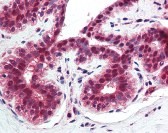
Immunohistochemistry staining of TNFRSF10A in breast tissue using TNFRSF10A monoclonal Antibody.| Product Name | TNFRSF10A Antibody |
|---|---|
| Antibody Type | Primary Antibodies |
| Antigen Alias | TNFRSF10A, APO2, CD261, DR4, TRAIL-R1, TRAILR-1, TRAILR1, TRAIL receptor 1, CD261 antigen, Cytotoxic TRAIL receptor, Death receptor 4 |
| Product description | Cells undergo programmed cell death (Apoptosis) in response to various stimuli. Apoptosis is essential for morphogenesis, tissue homeostasis, and host defense Apoptosis is induced by certain cytokines including TNF and Fas ligand in the TNF family through their death domain containing receptors, TNFR1 and Fas. A novel death domain containing receptor was recently identified and designated DR4 (for death receptor 4). The ligand for this novel death receptor has been identified and termed TRAIL (3,4), which is a new member in the TNF family. DR4 is also called TRAIL receptor-1 (TRAIL-R1). DR4 is expressed in most of human tissues including spleen, peripheral blood leukocytes, small intestine and thymus. Like TNFR1, Fas and DR3, DR4 mediates apoptosis and NF-κB activation in many tissues and cells. Apoptosis, or programmed cell death, occurs during normal cellular differentiation and development of multicellular organisms. Apoptosis is induced by certain cytokines including TNF and Fas ligand in the TNF family through their death domain containing receptors, TNFR1 and Fas. A novel death domain containing receptor was recently identified and designated DR4 (for death receptor 4)1. The ligand for this novel death receptor has been identified and termed TRAIL, which is a new member in the TNF family. DR4 is also called TRAIL receptor-1 (TRAIL-R1). DR4 is expressed in most of human tissues including spleen, peripheral blood leukocytes, small intestine and thymus. Like TNFR1, Fas and DR3, DR4 mediates apoptosis and NF-κB activation in many tissues and cells. |
| Immunogen | TNFRSF10A monoclonal antibody was raised against a peptide corresponding to amino acid 1 to 20 of TNFRSF10A (Human). |
| Clonality | Monoclonal |
|---|---|
| Isotype | IgG1 |
| Host Species | Mouse |
| Tested Applications | FACSIHCNeutWB |
| TNFRSF10A antibody can be used in immunohistochemistry starting at 10 μg/mL.: |
|
| Species Reactivity | Human |
| Concentration | 1mg/ml |
| Purification | Protein G |
| Gene Symbol | TNFRSF10A |
|---|---|
| Alternative Names | TNFRSF10A APO2 CD261 DR4 TRAIL-R1 TRAILR-1 TRAILR1 TRAIL receptor 1 CD261 antigen Cytotoxic TRAIL receptor Death receptor 4 |
Application
Immunohistochemistry staining of TNFRSF10A in breast tissue using TNFRSF10A monoclonal Antibody.| Application Notes | TNFRSF10A antibody can be used in immunohistochemistry starting at 10 μg/mL.: |
|---|
| Form | Liquid |
|---|---|
| Storage Instructions | TNFRSF10A antibody can be stored short term 4 ˚C. For long term storage aliquot and store at -20 ˚C. As with all antibodies avoid freeze/thaw cycles. |
| Storage Buffer | PBS, 0.05% BSA, 0.05% sodium azide. |


